Tuesday, June 30, 2015

The Men Who Moil for Walruses: Day 215


"Strange things are done, 'neath the midnight sun, by the men who moil for walruses."
                                                                                                    - Robert Service

For those who are unfamiliar with Robert Service's The Cremation of Sam McGee, it is probably worth mentioning that the line above is intentionally misquoted.  According to Mr. Service, the only ones doing strange things under the midnight sun are men who moil for gold, however given that this photo was taken somewhere between midnight and 3 in the morning, I think my amended quote is equally appropriate. Cruising around the sea ice in small  boats in the middle of a light-filled night, collecting skin and blubber biopsies from walruses using crossbows definitely qualifies as strange in my book.  Sometimes, though, in the midst of it all, the strangeness fades and becomes something else.  In this case, something serene.  The wind had calmed until it was barely a breath, and the water had taken on an almost oily stillness.  Solstice had come and gone, and even the midnight sun was beginning to tire, dipping close enough to the horizon to add a touch of pastel color to the clouds and soften the lighting of the sky.  In the foreground a healthy, adult walrus is contemplating it all, perhaps thinking about the meaning of its existence.  Though the sheer size, worn quality of the tusks, and excessive wrinkling of the skin around the neck might point towards this animal being a bull, she is in fact an old girl, of nearly monumental size and imperturbable character.  Which is to say, we biopsied her and she didn't even flinch.  Thank you, old girl, for the sample, the photo, and the memory I won't soon forget.

- Casey

Canon EOS Digital Rebel XT1, Canon EF 70-200mm f/4L USM, ISO-100 f/4.5 @ 1/125 sec.

Monday, June 29, 2015

Casey Returns: Day 214


After spending a month chasing walrus around the ice edge in Chukchi Sea, Casey and three of his fellow crew members finally arrived back at St. Paul yesterday. Fortunately for me he gets to stick around until Wednesday to clean and 'put away' the three boats. The rest of his crew already flew back to Anchorage.

Canon EOS 60D, Canon EF 70-200mm f/4L USM +1.4x, ISO-320 f/5.6 @ 1/2500 sec.

Here's a map of the ships track line over the past month.


Sunday, June 28, 2015

Tube Nose: Day 213


If you think these are gulls, you're probably not alone. This is a common mistake. Although similar in size, shape, and plumage, they are in fact not gulls. These are northern fulmars, a member of the Procellariiformes, an order which consists of some of the most iconic seabirds around. This group is less formerly referred to as the 'tube noses', due to a unique tubular structure formed around the nostrils shared by all members of the Procellariiformes. Fulmars, and their relatives the albatrosses, shearwaters, petrels, storm-petrels, and prions, have all demonstrated an incredible sensitivity to smell. Pour some fish oil over the side of a boat, and in a matter of minutes 'tube noses' will arrive to investigate. It's assumed that these tubular nasal passages help to funnel smells drifting in the wind, and direct birds to areas of high productivity and potential prey. You can think of fulmars as sort of a stockier miniature version of an the albatross, soaring vast distances across the ocean in search of food.

Canon EOS 60D, Canon EF 70-200mm f/4L USM + 1.4x, ISO-500 f/5.6 @ 1/2500 sec.

Saturday, June 27, 2015

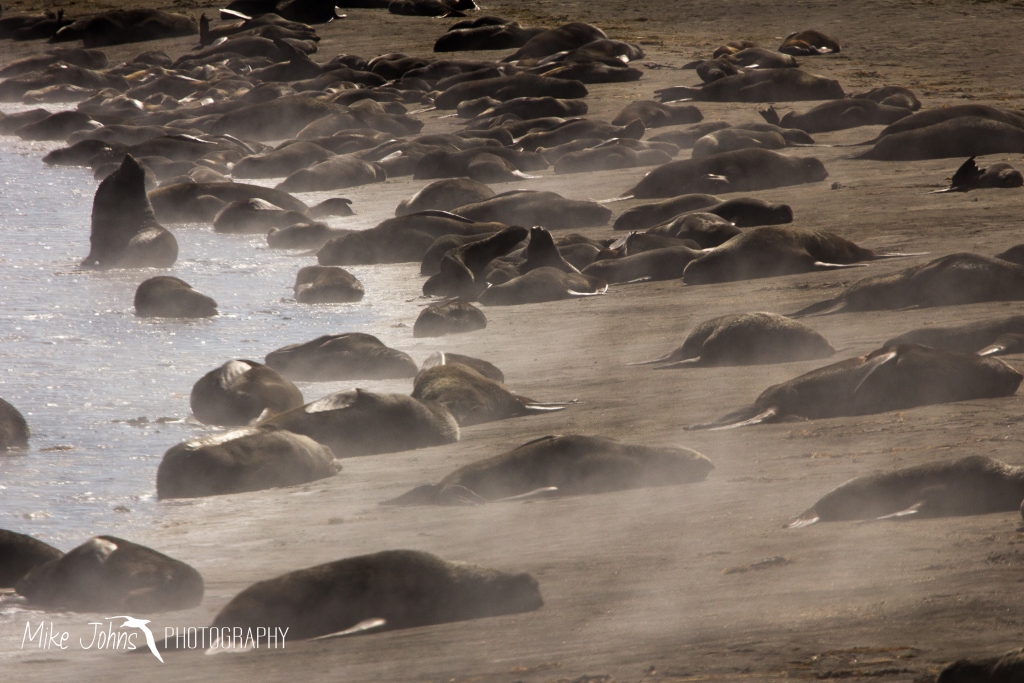
Seal Sauna: Day 212


Warm sun and cold sand; on days like this it must feel pretty good to be a fur seal.

Canon EOS 60D, Canon EF 70-200mm f/4L USM + 1.4x, ISO-400 f/5.6 @ 1/5000 sec.

Friday, June 26, 2015

A Big Day: 211


A parakeet auklet's reaction to this mornings historic supreme court same sex marriage ruling.

Canon EOS 60D, Canon EF 70-200mm f/4L USM + 1.4x, ISO-500 f/5.6 @ 1/320 sec.

Thursday, June 25, 2015

Concerned Citizen: Day 210


This horned puffin emerged from its nesting crevice while I was leaning over a cliff ledge checking on some red-faced cormorant nests. Curious encounters like this from puffins and auklets really help to break up the monotony of waiting for a sleeping cormorant to stand.

Canon EOS 60D, Canon EF 70-200mm f/4L USM + 1.4x, ISO-500 f/5.6 @ 1/800 sec.

Wednesday, June 24, 2015

Eggs: Day 209


Four out of the five species of seabirds we're monitoring for productivity now have eggs. Red-faced cormorants were the first to lay, followed by black-legged and red-legged kittiwakes last week, and just yesterday we had our first thick-billed murre egg. Now we're just waiting on the common murres. Productivity monitoring basically entails sitting and waiting for birds to stand, to determine the timing and quantity of eggs produced and chicks that hatch, and eventually fledge to sea. Obviously we can't monitor every single nest on the island, so we have plots set up throughout the different sub colonies. This thick-billed murre was not interested in incubating, which made finding its egg rather easy. Normally these birds are sitting tight, which means I also have to sit tight and watch for hours in order to see the contents of all the birds within a plot.

Canon EOS 60D, Canon EF 70-200mm f/4L USM, ISO-400 f/5.6 @ 1/500 sec.

Tuesday, June 23, 2015

A Different Kind of Light Show: Day 208


The data from last night's auroral activity are huge. The planetary K-index, or Kp scale, represents the magnitude of a geomagnetic storm, like the Richter scale for earthquakes or the Fujita scale for tornadoes. If I were to tell you a magnitude 9 earthquake had just struck the Aleutian Islands (which it hasn't), your reaction would be "damn, that's a big earthquake". Well, the Kp scale of geomagnetic activity ranges from 0-9, 9 being the most active. Last night the Kp index topped out at an 8. Damn, that's a big aurora. People were reporting lights all across the northern portion of the US, with displays reaching as far south as the Moab Desert in Utah. I had hoped last night would be my chance for St. Paul auroras, but a forecast for rain sent me to bed. I was, however, awoken by a sudden 3am thunder storm that lit up the skies above St. Paul anyway. Lightning, the next best natural phenomenon after aurora.

Canon EOS 60D, Canon EF 17-40mm f/4L USM, ISO-100 f/4 @ 10 sec - through a dirty window.

Monday, June 22, 2015

Summer Solstice: Day 207


The hills are alive, with the sounds of seabirds. Summer kicked off on St. Paul island with a thick layer of fog, but persistent dreariness really makes you appreciate the sun when it eventually shows itself. Like in the photo above, looking down into emerald blue water from High Bluffs on a sunny afternoon.

Canon EOS 60D, Canon EF 17-40mm f/4L USM, ISO-160 f/5.6 @ 1/400 sec.

Sunday, June 21, 2015

Tiny World - St Paul Edition: Day 206


The Bering Sea is not known for pleasant weather and flat seas. It's usually either windy, foggy, or both in the summer. So we took advantage of the perfect conditions we've been having and made the five mile trip south to Otter Island for a survey. While out on the boat, I snapped a long series of panoramic shots of St. Paul Island from the water. Whenever I make a panorama I always like to see what they look like as "tiny worlds". It only takes a few steps in Photoshop to wrap the image into a sphere. So here's what the continent of St. Paul would look like. A list of the dominate hills from west to east (top of the world going clockwise) are as follows: Rush, Ridge, Cone, Crater, Slope, Bogoslov, and Polovina - directly behind the two water tanks in town. The steep cliffs (dark patches on the coastline) are where we do the bulk of our seabird monitoring, and are listed clockwise as follows: High Bluffs (noon), Ridgewall (1 to 3 o'clock), Zapadni (5 o'clock), Tolstoi (9 o'clock), and Reef (11 o'clock).

Canon EOS 60D, Canon EF 70-200mm f/4L USM +1.4x, ISO- 320 f/5.6 @ 1/3200 sec, 15 image panorama stitched and distorted in Photoshop CS.

Saturday, June 20, 2015

Poppy: Day 205


After three consecutive days of sunshine, this island has transformed into a garden of wildflowers. Shades of yellows, pinks, and purples dot the landscape like paint spattered on a green canvas. These yellow poppies attract the most attention from the eye, growing along the shoulder of the dirt roads here on St. Paul.

Canon EOS 60D, Canon EF 17-40mm f/4L USM + Canon EF 25mm Extension Tube II, ISO-400 f/5.6 @ 1/1600 sec.

Friday, June 19, 2015

Fur Seals: Day 204


Much of past 200 years of human habitation on St. Paul Island is tied to this animal, the northern fur seal. Rumors of vast rookeries in the far north eventually led to the discovery of these islands by Gavrill Pribylov in the 18th Century, and the rumors quickly proved to be true. Roughly 500,000 northern fur seals breed on the Pribilof Islands, representing half the the estimated world population, with a range that extends throughout the Bering Sea and down to Baja California in the east and the southern tip of Japan in the west. The beaches out here are slowly becoming congested with animals arriving for the start of the breeding season, their low growls and groans echoing across the island like mythical sea monsters.

Canon EOS 60D, Canon EF 70-200mm f/4L USM + 1.4x, ISO-400 f/5.6 @ 1/1250 sec.

Thursday, June 18, 2015

Snow Bunting: Day 203


Situated precariously west of mainland Alaska, St. Paul Island is frequently invaded by European and Asian vagrants. Misguided by fog or blown off course by strong winds, land birds seek shelter on this remote rocky refuge after finding themselves lost over the unforgiving Bering Sea. Unlike seabirds which thrive on the wind and waves, land birds are unable to rest on the water's surface, and must find something solid to perch upon. Bird fanatics, for lack of a better term, have caught on to this phenomenon, and pay thousands of dollars to spend several days on St. Paul, relentless searching for those prized species to add to their life lists. This snow bunting is by no means rare or vagrant, and is an abundant local breeder found throughout the colder reaches of North America. Still if, like me, you're from California, it's one to add to the life list. Not that I'm keeping track of course.

Canon EOS 60D, Canon EF 70-200mm f/4L USM + 1.4x, ISO-400 f/5.6 @ 1/4000 sec.

Wednesday, June 17, 2015

City of St. Paul: Day 202


A view of "down town" St. Paul on a rare sunny afternoon, from Reef Point looking north across Gorbalch Bay. According to the US Bureau of Labor and Statistics, roughly 500 people live within the city of St. Paul, although that number is likely slightly inflated. Prior to the discovery of the Pribilofs by Russian fur traders in 1786, St. Paul island has uninhabited. Native Aleut people never made the journey out this far, and with the weather we've been experiencing lately, that's not surprising. The Russian-American Fur Company did however bring Aleut people over from Atka and Unalaska as slaves to harvest northern fur seals, several years after the discovery of the islands. Many years later, after fur pelts went out of fashion and the demand for fat-oil subsided, the federal government eventually granted the Aleuts of St. Paul a pardon. They now manage a small subsidence harvest of the fur seals ever year.

Canon EOS 60D, Canon EF 85mm f/1.8 USM, ISO-100 f/10 @ 160 sec, 8 image panorama stitched using Photoshop CS.

Tuesday, June 16, 2015

Casey: Day 201


Been thinking a lot about this guy lately. No it's not a photo from today, but it's Casey's birthday and I haven't seen a sunset in quite a long time, so it just feels right. This was taken at San Onofre in southern California, when we spent two weeks living out of my truck and surfing every day. It was the best of times.

Canon EOS 60D, Canon EF 17-40mm f/4L USM, ISO-800 f/7.1 @ 1/200 sec + flash.

Monday, June 15, 2015

200 Days Complete


Today is the 200th day of pictures. I am now just over half way done with this photo-a-day project. A year sure is a long time. I started this project to keep me busy over a slow winter, and now that I'm back to work with things to do, it keeps me even busier. I've spent the last 20 days staring at these red-faced cormorants, waiting for them to stand and reveal their secrets, and I'll be spending the next 80 doing the same, so I feel they are a fitting subject to commemorate this milestone. 165 days to go...and counting.

Canon EOS 60D, Canon EF 70-200mm f/4L USM, ISO-400 f/5.6 @ 1/1250 sec.

Sunday, June 14, 2015

Stickleback: Day 199


The bulk of the work conducted by the fish and wildlife service on St. Paul revolves around seabird productivity monitoring. We have plots distributed throughout prime nesting habitat, that we visit on a rotating schedule every three days. For many hours, we sit on the edge of a cliff, and using either a scope or binoculars, note the status (i.e. bird, bird/egg, bird/chick, etc) of all the birds within the plots. We do, however, have side projects that add a little variety to our daily schedule. For instance today we are heading to a nearby pond to collect stickleback from traps we set yesterday. Stickleback are small minnow-sized fish found in both fresh and salt water systems throughout the northern hemisphere. Those that become trapped in ponds and lakes, like the ones here on St. Paul, make excellent subjects for studying evolution. Just like Darwin's finches, isolated populations of these small fish, unable to exchange genetic information with neighboring populations, have evolved different morphology on a relatively brief timescale. For example stickleback found in the ocean contain up to ten times more armor plating than those in fresh water systems. This is likely a response to predatory pressures, a heavier armor protects against fast moving predatory fish in the ocean, whereas a lighter armor, mostly around the head, makes the stickleback faster, and protects against slow moving predatory insects in fresh water. That's the gist of it anyway. Interesting stuff.

Canon EOS 60D, Canon EF 17-40mm f/4L USM, ISO-400 f/7.1 @ 1/125 sec.

Saturday, June 13, 2015

Flowers: Day 198


Spring is a little delayed up here in the northern latitudes, but better late than never. All over the island small colorful wildflowers are emerging from fresh new green growth, creating carpets of yellows, purples, and whites. This photo of a patch of Sulphur Buttercups was taken up at a place called High Bluffs, on the western side of the island.

Canon EOS 60D, Canon EF 17-40mm f/4L USM, ISO-200 f/4 @ 1/800 sec.

Friday, June 12, 2015

All Terrian: Day 197


To some people St. Paul Island is home, they live out here full time. It's a proper town, with a town hall, a church, a police station, a grocery store, a museum, a post office, a marina, a bar, a cemetery, and of course a smattering of houses and government facilities. Most of this infrastructure is centered on a small peninsula on the extreme southern end of the island. The remaining 43 square miles of St. Paul, with the exception of the airport, a few small structures and ponds, are mostly open tundra. Well groomed roads lead about 6 miles out of town in three different directions: west, north, and northeast. From there, a series of ATV trails connect the circumference of the island. Most of the sites where we monitor seabirds are located off the well groomed road leading west, but a few can only be accessed via the northwest ATV trail. It's a jarring bumpy ride that takes a little over an hour to complete. This photo was taken from the northwest side of the island, looking east to North Hill (left) and Low Hill (right).

Canon EOS 60D, Canon EF 17-40mm f/4L USM, ISO-200 f/16 @ 1/320 sec.

Thursday, June 11, 2015

Crested Auklet: Day 196


Crested auklets may very well be the most entertaining bird to watch out here. Aside from their candy-corn bill and decorative head gear, these auklets also use auditory and olfactory signals to establish pair bonds and to compete with other birds during mate selection. They have a very distinct barking call that seems to trump all other sounds of the colony, which they produce while sitting on the water, flying in flocks, and climbing around the cliff faces. I haven't smelled it yet, but crested auklets release a citrus-like odor when their nape feathers are ruffled. This cloud of citrus apparently induces the "ruff sniff" display, where birds will insert their bill into the plumage of another. A bird that smells like oranges, now not is certainly unique.

Canon EOS 60D, Canon EF 70-200mm f/4L USM + 1.4x, ISO-400 f/5.6 @ 1/2000 sec.

Wednesday, June 10, 2015

Smelling The Roses: Day 195


I'm often guilty of moving from point A to point B without taking the time to observe the little things around me. For instance when I'm on the road and there's a scenic turnout ahead, I won't stop. I few days back I was hiking up a bluff to a site where we monitor nesting seabirds, when I noticed this brightly colored beetle buried in the grasses. It's species name is Carabus truncaticollis, an arctic species common in Russia and Asia, and found in some locations at the top of North America. Other than it has pretty colors, that's about the breadth of my entomological knowledge of this beetle. Sometimes it's worth stopping to smell the roses.

Canon EOS 60D, Canon EF 17-40mm f/4L USM + Canon EF 25mm Extension Tube II, ISO-320 f/5.6 @ 1/320 sec.

Tuesday, June 9, 2015

You Lookin' At Me?: Day 194


Seabirds have the most interesting eyes. This portrait of a parakeet auklet is yet another addition to my ongoing collection of birds looking straight at the camera, which I may someday develop into a coffee-table book entitled "Birds, (long pause) Head On".

Canon EOS 60D, Canon EF 70-200mm f/4L USM + 1.4x, ISO-250 f/5.6 @ 1/500 sec.

Monday, June 8, 2015

Black to Green: Day 193


St. Paul Island is made up entirely of basaltic rock and pyroclastic tuff from volcanism which ended some time in the late Pleistocene, roughly 12,000 years ago. Extinct cinder cones that dominate the outline of the island, once spewed huge volumes of lava over the landscape, creating solidified flows of twisted black rock. Some of the eruptions were evidently violent, burping out massive clouds of frothy pyroclastic flows, which left behind porous clumps of craggy red rock. If St. Paul were situated in a warmer wetter climate, it could easily be mistaken for a Hawaiian Island. This island, however, is far from the tropics, and the stark black volcanic rock supports no forests or bushes. Vegetative life on St. Paul is stunted by strong winds, a short growing season, and a long cold winter. Still, slowly but surely, leaves are beginning to appear, and soon the island will be blanketed with a lush carpet of green grasses and colorful wildflowers.

Canon EOS 60D, Canon EF 85mm f/1.8 USM + Canon EF 25mm Extension Tube II, ISO-200 f/4.5 @ 1/160 sec.

Sunday, June 7, 2015

Bones: Day 192


This a single vertebrae from the spine of a minke whale, a small baleen whale occasionally spotted around St. Paul. The long flat vertebral processes are characteristic of a whale, and I know its from a minke because the skull was about a mile up the beach. Judging from the length of the spinous process (or vertical, long bit pointing right), I would assume this puzzle piece fits into the lumbar region of the spine, an area with restricted twisting motion that mainly supports the up and down swim pattern of an marine mammal. Huge muscles that controlled this whale's propulsion ran from the base of the skull all the way to the flukes, and would have laid on top of the two transverse processes (or horizontal, two bits pointing up and down) like a slab of meat on a shelf. It's difficult to see in this photo, but in each vertebrae where the three processes meet there's a hole. When combined these holes create a channel that protects the nerves and blood vessel running the length of the body. Nothing like a bit of whale anatomy over a morning coffee.

Canon EOS 60D, Canon EF17-40mm f/4L USM, ISO-200 f/16 @ 1/160 sec.

Saturday, June 6, 2015

Locks: Day 191


An arctic fox shedding its winter coat in preparation for a brief summer. This is almost as bad as when Reef sheds.

Canon EOS 60D, Canon EF 70-200mm f/4L USM + 1.4x, ISO-320 f/5.6 @ 1/800 sec.

Friday, June 5, 2015

It's Cold Out Here: Day 190


The weather here on St. Paul can be tricky for a morning person like me. Typically a cold damp fog looms over this low lying island until about noon, lifting in the afternoon to a high overcast ceiling. We don't bother starting work until around 11am. If we're lucky, and this is rare, the clouds part enough to allow a bit of light in, however blue skies are often coupled with a stiff breeze off the chilly Bering Sea. Situated at 57 degrees north, the sun is up for nearly 18 hours, so we have plenty of day-length to wait for a good weather window. This is a view from High Bluffs on the west side of the island, looking north.

Canon EOS 60D, Canon EF 17-40mm f/4L USM, ISO-200 f/11 @ 1/125 sec.

Thursday, June 4, 2015

Tufted Puffin: Day 189


The elaborate ornamentation of the tufted puffin, sexual selection at its best. Natural selection does a great job at explaining the evolution of morphological, physiological, and behavioral traits of a species, but falls short in providing a rationale for say, the extreme head gear of a tufted puffin. Shorter wings are good for swimming, a darker plumage helps reduce detection from prey, but what advantage do golden rock-star head plumes provide? The answer lies in sexual selection, which focuses only on reproductive success. The development of "attractive" ornamentation provides a gained mating advantage over other birds, it's the mechanism for attracting a mate. Allow sexual selection to run its course for millions of years, and fashions begin to spin out of control in order to maintain the advantage. We've seen this happen before, in the 80's.

Canon EOS 60D, Canon EF 70-200mm f/4L USM + 1.4x, ISO-400 f/5.6 @ 1/800 sec.

Wednesday, June 3, 2015

Rock Art: Day 188


We see a slab of exposed weathered rock.They see a blank canvas. Murres, they're so abstract.

Canon EOS 60D, Canon EF 70-200mm f/4L USM + 1.4x, ISO-800 f/5.6 @ 1/500 sec.

Tuesday, June 2, 2015

Red-faced Cormorant: Day 187


Red-faced cormorants nest throughout the Aleutian Islands and into the Gulf of Alaska, with the Pribilof Islands colonies marking the extreme northern limit of their range. As black-legged kittiwakes continue to show little interest in nesting this season, red-faced cormorants have been our primary focus so far on St. Paul. Currently we are monitoring 68 nests in productivity plots throughout various sites around the island, many nests with pairs already incubating a clutch of 2-3 eggs. Amazingly, a few days back we already spotted the first chick of the season, a major deviation from a mean hatch date typically in late June.

Canon EOS 60D, Canon EF 70-200mm f/4L USM +1.4x, ISO-400 f/5.6 @ 1/800 sec.

Monday, June 1, 2015

Puffin - Auklet Combo: Day 186


The award for best decorative head gear among the birds of St. Paul would have to be a close tie between the tufted puffin and crested auklet. Most seabird species have relatively uninspiring plumage, with bodies cloaked in feathers colored on a monochromatic scale. Some Alcids in particular make up for this drab existence by developing fiery orange bills and flashy head plumes in the breeding season. Tufted puffins have been hanging around the cliffs in high numbers ever since we arrived on island, but crested auklets are just beginning to make an appearance, or at least I've only just begun to notice they're around.

Canon EOS 60D, Canon EF 70-200mm f/4L USM + 1.4x, ISO-400 f/5.6 @ 1/500 sec.

Sunday, May 31, 2015

Red-legged Kittiwake: Day 185


This is a red-legged kittiwake (Rissa brevirostris), brevi meaning short, and rostris meaning nose, or in this case a bill. Aside from the bright red legs, a shorter bill is one way to tell these birds apart from a more ubiquitous species the black-legged kittiwake. Breeding only on a few select islands in the Bering Sea, roughly 80% of the world's population of red-legged kittiwakes nest here on the Pribilof's, mostly on St. George just south of St. Paul. Currently they are working on building precarious nest platforms constructed of mud and grass, perched atop slight rock ledges on the sides of steep vertical cliff faces.

Canon EOS 60D, Canon EF 70-200mm f/4L USM + 1.4x, ISO-400 f/6.3 @ 1/320 sec.

Saturday, May 30, 2015

Not So Fantastic Mr. Fox: Day 184


Today, while scouting for glass floats along a stretch of sandy beach on the north side of the island, I came across a rather unusual arctic fox. Unlike other Alaska Islands plagued with introduced foxes, animals naturally made their way out to the Pribilof's on winter pack ice. Arctic foxes are everywhere on St. Paul. Generally a fox will run away when approached, but this one just laid there and growled at me. In fact, I hadn't noticed I was standing nearly on top of it until it started growling. It appeared slightly dazed and too weak to move. Old age? Sick? Rabies? Either way I left it alone and continued on my way. No glass floats this time.

Canon EOS 60D, Canon EF 70-200mm f/4L USM +1.4x, ISO-400 f/5.6 @ 1/500 sec.

Friday, May 29, 2015

Horned Puffin: Day 183


Less obscure than say, a storm-petrel, the one seabird most people have probably heard of, either through popular culture or natural history films, is the puffin. The clowns of the sea. Their brightly colored toucan-like bills and ornate head gear demand attention. As with the rest of the alcids, puffins are restricted to the northern hemisphere, where three species occur and breed in crevices on offshore islands throughout the high latitudes. The Atlantic Ocean contains a single species, appropriately named the Atlantic puffin, and on the Pacific side we have two species, the tufted and horned puffins. With nearly identical ranges, tufted puffins venture slightly further south, with colonies as far down as the Farallon Islands off central California. Horned puffins remain north of Vancouver Island in Canada, although occasional sightings do occur further south. Both Pacific species are a common sight during the summer months on St. Paul. By-the-way, it's been in the high 30's and low 40's this past week, with wind gusts from the frigid Bering Sea at times up to 40 knots...so I use the term 'summer' rather loosely.

Canon EOS 60D, Canon EF 70-200mm f/4L USM + 1.4x, ISO-200 f/5.6 @ 1/2000 sec.

Thursday, May 28, 2015

Hello and Goodbye: Day 182


Out of sheer coincidence, Casey and I found ourselves together on the same remote Bering Sea island, but only for a night. He and the rest of his crew flew in from Anchorage on Tuesday, and due to high seas and a strong southeast wind, were forced to stay for a night at staff quarters (the large white building on the upper left). I was able to at least give him a quick tour of the southwest portion of the island, and show him some of the cliffs that will soon be full of nesting seabirds. With a brief weather window yesterday, they managed to transport all gear and personnel to the Russian vessel Professor Multanovskiy, which was stationed beyond international waters 12 miles in the lee of St. Paul. Soon they will be passing the Bering Strait, looking for walrus at the edge of the ice somewhere in the Chukchi Sea.

Canon EOS 60D, Canon EF 17-40mm f/4L USM, ISO-400 f/5.6 @ 1/800 sec.

Wednesday, May 27, 2015

Thick-billed Murre: Day 181


Continuing with the tour of birds on St. Paul, next is the thick-billed murre. They form mixed breeding colonies alongside common murres, a familiar seabird off California. At first glance the two species might seem identical, but look closer and you'll see that thick-billed murres have a white stripe extending from the gape on the upper mandible, and the white breast feathers form an inverted "V" on the throat. They are also slightly beefier than common murres, with a heavier head and bill. Thick-billed murres are a circumpolar breeder, with colonies throughout the arctic and sub-arctic waters of Alaska, Russia, Canada, and Greenland. Ecologically murres fulfill the same niche in the northern hemisphere as penguins in the south, however murres have retained their ability to fly - but just barely.

Canon EOS 60D, Canon EF 70-200mm f/4L USM + 1.4x, ISO-400 f/6.3 @ 1/320 sec.

Tuesday, May 26, 2015

Northern Fulmar: Day 180


Whenever I see a northern fulmar, I'm reminded of winters in Monterey. Walking down uneven wooden planks, coffee in hand, I take the boat through the jaws just as the sun's orange light begins filtering through dark cumulus clouds to the east, the harbor air damp with the smell of wet gull poop. With a small load of maybe 20 passengers, we head out into a crisp breezy sea, the morning light creating golden spray off the crests of big winter swells. The forecast calls for rain, but with weather holds for at least the morning. Passing Cannery Row and the lighthouse at Point Pinos, we spot our first group of gray whales, lumbering along just outside the kelp canopy, stragglers on the long migration north. And in the distance beyond the whale blows, pitching back and forth in a steady wind, are northern fulmars; their vibrant white plumage contrasting sharply with a dramatic winter sky. For me, fulmars mean winter, but in the summer, St. Paul Island is one of many breeding destinations for these open ocean birds.

Canon EOS 60D, Canon EF 70-200mm f/4L USM + 1.4x, ISO-250 f/6.3 @ 1/320 sec.

Monday, May 25, 2015

Least Auklet: Day 179


By no means my least favorite auklet on St. Paul, is the least auklet. In fact they might be my favorite. No bigger than a song sparrow, they are the smallest species in the family Alcidae (puffins, auklets, guillemots, murres, murrelets, etc.). With breeding colonies as far north as the Bering Strait, these small seabirds range throughout the Bering Sea and Aleutian Islands, with a population somewhere around 20 million. They remain close to their respective breeding islands year-round, moving south in the winter only in extreme northern latitudes to escape advancing sea ice. Unlike murres and other wing-propelled pursuit divers, which can reach depths of over 100 meters, the small size and high buoyancy of least auklets restrict their dives to within 25 meters of the surface. Thus, they almost exclusively forage on slow moving swarms of copepods along tidal rips and thermal fronts.

Canon EOS 60D, Canon EF 70-200mm f/4L USM + 1.4x, ISO-200 f/6.3 @ 1/800 sec.

Sunday, May 24, 2015

Parakeet Auklet: Day 178


On the west coast of North America, from Baja to the Gulf of Alaska, two types of stocky burrow nesting seabirds called auklets occur, the Cassin's and rhinoceros auklet. Here in the Bering Sea, and throughout the Aleutian Island chain, a higher diversity of more decorated species of auklets can be found, and the most widely distributed of all Alaskan auklets is the parakeet auklet. What sets this species apart is their nearly circular orange bill, which due to its shape likely aids in the capture of gelatinous prey such as jellies. These chatty birds lay a single egg in crevices within the jumbled black volcanic rock cliff faces here on St. Paul, and are often standing around in pairs during the day. They breed throughout the summer months, and disperse far out to sea in the winter.

Canon EOS 60D, Canon EF 70-200mm f/4L USM + 1.4x, ISO-400 f/5.6 @ 1/500 sec.

Saturday, May 23, 2015

Island Reindeer: Day 177


You wouldn't expect to see these furry antlers all the way out in the Bering Sea, but here they are. In 1911, the US government brought over 25 reindeer to St. Paul Island, and by 1938 that initial herd exploded to 2,000 animals. No population can expand indefinitely, a carrying capacity is bound to be met, and a few years later reindeer numbers on St. Paul crashed from overgrazing and harsh winters. After several more re-introduction attempts, both St. George and St. Paul now have stable, if not growing, herds of reindeer that are hunted periodically mostly by visitors to the islands.

Canon EOS 60D, Canon EF 70-200mm f/4L USM + 1.4x, ISO-400 f/9 @ 1/800 sec.

Friday, May 22, 2015

What is she Steve?: Day 176


That's a quote from the movie "Life Aquatic" if you're not familiar with it. While driving around the northwest side of the island yesterday, checking on which plots contain birds this year, we ran into some birders who reported seeing a strange looking large carcass just down the beach. We noticed a smell driving by on the ATV track, but somehow missed it. So we went back to have a look. Walking down to the pile of blubber I was initially puzzled by the strange smooth vertebrae and huge size. Unfortunately the head was missing or tucked underneath, but based on its pinniped-like arm bones and what appeared to be a sacrum, it had to be a walrus and not a whale. Wave action must have knocked off the vertebral processes that should be present on a marine mammal spine. That was one big walrus.

Canon EOS 60D, Canon EF 17-40mm f/4L USM, ISO-320 f/16 @ 1/160 sec.

Thursday, May 21, 2015

Welcome To St. Paul: Day 175


Greg and I departed Homer at 0730 yesterday, and with a three hour layover in Anchorage, left for St. Paul at 1145. After a brief and windy stopover in Dillingham half way through the flight for fuel, we finally touched down on St. Paul just before 1600. My initial impressions of the island were: it's big, it's stark, and I'm going to have a lot of fun getting to know the place. We took a drive down to the southwest corner to check out some of the seabird cliffs we'll be monitoring, and within minutes saw a horned puffin, red-legged kittiwakes, red-faced cormorants, a thick-billed murre, rosy finches, and snow buntings. Birds I will soon become very familiar with, but for now are pretty incredible to see for the first time. Today, cleaning and organizing gear, and some more exploring of the island.

Canon EOS 60D, Canon EF 17-40mm f/4L USM, ISO-400 f/7.1 @ 1/250 sec.

Wednesday, May 20, 2015

Departure: Day 174


Today's the big day. I'm leaving the comforts of home once again and heading out into the unknown. I've heard the stories, seen the photos, and read the materials, and now I'm ready to experience the Pribilof Islands for myself. So long Homer.

Canon EOS 60D, Canon EF 17-40mm f/4L USM, ISO-200 f/14 @ 1/160 sec.

Tuesday, May 19, 2015

Kenai Peninsula: Day 173


Landed in Anchorage yesterday afternoon and drove four hours down the Kenai Peninsula back to Homer. It was cool to see the Tanana Valley full of green trees and blue bogs on the flight from Fairbanks. I even spotted a pod of roughly 50 Belugas in the tidal flats on the approach to Anchorage. I leave for St. Paul Island early tomorrow morning, arriving some time in the late afternoon if the weather cooperates.

Canon EOS 60D, Canon EF 17-40mm f/4L USM, ISO-125 f/10 @ 1/160 sec.

Monday, May 18, 2015

Floatn' The Chena: Day 172


Eighty degrees and a slight breeze to keep the mosquitoes at bay, this is a Fairbanks I could get used to. Yesterday Casey, Reef, a group of friends, and myself "put in" at Paddler's Cove two canoes, a pack raft, and a cataraft and floated down the meandering Chena River. After stopping a the Boatel for beers and live music for a few hours, we continued down the Chena and finished the float at Pikes Landing. The sunshine was short lived, but worth it. Today, back to Homer and the dreary marine layer.

Canon EOS 60D, Canon EF 17-40mm f/4L USM, ISO-400 f/10 @ 1/125 sec. 

Sunday, May 17, 2015

Thawed: Day 171


The lake Casey and I ice skated on when I first arrived in Fairbanks last November is now a place for Reef to swim and fetch sticks.

Canon EOS 60D, Canon EF 17-40mm f/4L USM, ISO-200 f/4 @ 1/640 sec.

Saturday, May 16, 2015

Night and Day: Day 170


Since my flight to St. Paul has been delayed, and there's not much left to do around the office, I booked a last minute trip using frequent flyer points back home to Fairbanks for the weekend. Why not? I wanted to at least get a taste of summer in interior Alaska before I'm marooned on an island of perpetual fog. The birch trees have exploded with brilliant green foliage, and the warm sun is shinning long and bright. Here is a photo from our backyard, superimposed with a wedge of last winter for comparison.

Canon EOS 60D, Canon EF 17-40mm f/4L USM, ISO-400 f/7.1 @ 1/100 sec.

Friday, May 15, 2015

Bon Voyage: Day 169


The St. George crew boarded their flight for the Pribilofs early this morning, with a brief layover in Anchorage. Hopefully the Bering Sea will go easy on them and allow the plane to land with no delays.

Canon EOS 60D, Canon EF 17-40mm f/4L USM, ISO-640 f/4 @ 1/1250 sec.

Thursday, May 14, 2015

Tiglax: Day 168


It's pronounced 'tech-la', and she'll be departing Homer on Sunday bound for the Aleutian Islands, taking with her the anxious field crews of Chowiet, Aiktak, and Buldir. Unlike most of the far west Aleutians, the Bering Sea islands of St. Paul and St. George both have functioning runways with regularly scheduled flights, so my fellow Pribilonians and I won't get the luxury of traveling aboard the famous Tiglax.  St. George folks fly out early tomorrow morning, and my flight to St. Paul has been pushed back to Wednesday. Click HERE to view the 2015 Alaska Maritime field crew.

Canon EOS 60D, Canon EF 70-200mm f/4L USM +1.4x, ISO-200 f/7.1 @ 1/800 sec.

Wednesday, May 13, 2015

Training Continues: Day 167


A walk along the beach after an exciting day of database training and a round-table discussion on sexual harassment. All very important, all very dull. I promise it will get more interesting soon.

Canon EOS 60D, Canon EF 70-200mm f/4L USM + 1.4x, ISO-400 f/7.1 @ 1/3200 sec.