Friday, November 30, 2012

Goose Sighting

I’ve agreed to run a 5k on Christmas, involving many laps on the runway, and during my inaugural training run yesterday evening I noticed an odd looking bird flying in an unusual pattern high over the island. Frigate birds have a distinct soaring flight, with very distinct frigate bird shaped wings. This bird however had a chunky body, long neck, and a labored flight pattern, different from all other species that breed on the island. Immediately I made the connection, “that’s a damn goose”. Chad the current refuge manager on the island has worked with waterfowl in the past, and given the nearest mainland is roughly 5,000 miles away, I thought he’d be interested in the sighting. So I sprinted to the barracks and yelled…”Goose over the island!” grabbed my bins and ran back outside to get a better look; it was backlit before so I couldn’t make out any identifying field marks. Of course when I returned outside the bird had already disappeared. Typical. Also typical was the air of doubt in the responses from the others about my goose sighting. It’s tough when you’re the only one who spots something out of the ordinary.

Fortunately I got a report early this morning that the goose did in fact exist and was standing near meter marker 100 on the east end of the runway. So once again I grabbed the bins and my camera this time and hopped on the bike. Sure enough there it was being harassed by a group of noddies that had also realized a foreigner was invading their island home. It had the overall appearance of a Canada Goose, but was much smaller in size; compared to the albatross this thing was tiny. After consulting the internet, which is finally working again,  it turns out the mystery bird was a Cackling Goose (Branta hutchinsii), once thought to be a subspecies to the Canada Goose but was split into its own species status in 2004. There are currently five recognized subspecies of Cackling Goose now, all of which breed in the tundra around Canada and Alaska, wintering throughout most of western Canada, the US, and northern Mexico. They are sometimes found in eastern Siberia, China, and Japan; Japan being the possible final destination for this lost bird.


Wednesday, November 28, 2012

Stan


After finishing lifting weights in the gym, something I have never recreationally done before in my life but hey, when in Rome, Larry and I decided to jump off the dauphin. Not exactly sure what the proper definition of a dauphin is (notice the spelling lacks an L), but ours is a tall metal structure with a catwalk leading out to it that I believe was once used to tie up large ships. Naturally the dauphin is on the edge of a dredged channel, and I was thinking about diving in head first but chickened out. Striking the water in a pencil dive fashion I stuck my face in to look around, and as the bubbles cleared I noticed a large blob near the bottom against the seawall. Unable to focus without I mask, I wasn’t sure what to make of it.

“Hey Larry, looks like there’s some kind of large fish down here”

“What?”

I stuck my head in for another look and realized the blob was moving towards the surface, “at least I think it’s a fish, definitely large though”.

“Oh yeah?”

“Yeah…” the inflection in my voice changed from calm and observant, to slightly cautious, to… “Shit it’s swimming towards me!”

Finally the blob surfaced just a foot away from me. What emerged was a round dome with whiskers and cold black eyes; it was a young monk seal, not a shark. My heart was in my stomach…or is it my stomach was in my mouth? I can never get that expression right. We are required to keep our distance from any monk seals we encounter, and I think this one knew the game, for it was lingering around our exit, bobbing at the surface right in front of the ladder. Occasionally it would swim off slightly, but as soon as we got close to the ladder it would pop up and block access again. Maybe there was a shark down there after all and it was baiting us. Maybe this was a diabolical seal...perhaps named Stan. Maybe some former researcher or volunteer had harassed Stan as a pup, and now it’s seeking its revenge. Maybe its revenge was to have us torn to bits by the tiger shark lurking beneath our feet. Whatever its motivation the seal wouldn’t move…so eventually we just had to get bold, break protocol, and take charge of the ladder. It watched us clamber up the rusty metal rungs, and once we were back on the island it lost interest and disappeared, as if its plans for revenge had been foiled. I’m convinced Stan was out to get us…

Tuesday, November 27, 2012

Tour of the Atoll


Fierce winds and persistent rain squalls have been the predominate weather pattern for the past week, but a break in the storms allowed us to explore the outer islands of French Frigate Shoals. With a mirror sea and sunshine we ditched the day’s activities to take advantage of the conditions, loading both the grey and red whalers with enough gas and supplies for a roundtrip tour of the atoll. Roughly six miles at a heading 140 we reached East Island, a narrow sand spit half the size of Tern. We visit East typically once a week to remove invasive vegetation and count any seabirds that happen to be standing around, so we didn’t land here this time. East is where roughly 80 percent of all Hawaiian Green Sea Turtles nest, and where around 1,000 breeding pairs of albatross will soon nest. On clear days a tall telephone pole fixed with surveillance cameras used to broadcast streaming video of turtle activity is visible on the horizon.

Next on our stop was a pair of small sand islands, Gin and Little Gin, another 4.5 miles from East Island on the same bearing. The Gins are beautiful, two white sand mounds separated by a deep blue channel. Both are narrow and less than 100 meters in length. They periodically get washed over by large waves, so no permanent vegetation has taken root. The only items that breakout the bleak white sand are bits of trash and fishing gear from Asia, lounging monk seals, and loitering albatross. Aside from Disappearing Island on the southern fringe of the reef, the Gins are the southernmost islands of the atoll that remain constant above mean high tide. We counted about 100 albatross and a few Brown Noddies on both Gins, and collected a boogie board that had washed up from some distant civilization.  
The trip to the Gins had taken up most of our morning, so we decided to explore the pinnacles of reef that make French Frigate Shoals so notoriously dangerous, to find a good spot to snorkel (or as Larry would like to rename it ‘nature swimming’ since he feels it has a better ring to it than snorkeling) and have lunch. Leaning over the bow, we assisted Chad in navigating the deeper channels by pointing out shallow reef. The water was so unbelievably clear we could see green coral heads 50 feet down, though the brown ones 3 feet down were the ones to watch out for. With East Island back in sight as we worked north again, and the illusive La Perouse Pinnacle to the northwest, we came upon two round patches of shallow reef with a snaking channel between them. In lee of the atoll this would be a nice calm spot for a swim, so we pitched our anchors overboard, dawned our masks and jumped in. It was a gorgeous reef, the healthiest we’ve seen yet. Boundless diversity of both reef and fish, full of all the brilliant colors and shades of the rainbow. It was mind blowing to ponder we were the only four people in the water within a 500 mile radius, in the middle of the Pacific, within a crescent shaped rim of reef that once was a mighty island; nature swimming a spot that previously had never been seen by another set of human eyes... as far as we know. I made taquitos for lunch, and named this spot in their honor.

Flying over blobs of dark coral heads, watching our boat’s shadow glide over a sandy seabed in emerald blue water, we made our way from Taquito Reef to Round Island. Round has a radius of roughly 10 meters, so we didn’t bother landing on it. There were a few noddies and boobies hanging around along with a very small monk seal weaner, but other than that not much was happening here. Round once had a companion island called Mullet, which is currently eroded away and under water. Soon to be a growing trend for other islands of French Frigate Shoals as the ocean continues to rise over their banks. It’s predicted that in 100 years or less almost all the Northwestern Hawaiian Islands (Kure Atoll, Midway Atoll, Pearl and Hermes Atolls, Lisianski and Laysan Islands, and French Frigate Shoals) will be under water; forcing the seabirds, turtles, and seals to find some other trash laden islands to breed. 

Last on our stop was Trig Island, just a few miles east of Tern. Trig is protected by a very shallow and dense reef, so finding a passage to access the beach was a bit tricky. There is a well known narrow channel that can be difficult to find in the glare and dangerous to pass through in a swell, but we had sunny skies and calm seas, so we gave it a shot. A chunk of coral shaped like an anchor, called Anchor Rock, stands at the entrance of the channel and notes where to make the turn into the reef. After some skillful zigzagging through a coral mine field with finally anchored off the east side of Trig, and waded through placid water onto the beach. This was by far the most beautiful blue lagoon I have seen yet in French Frigate, with huge steep pinnacles of coral scattered throughout. After completing our census of birds on the island (and one turtle with a shark bite to its tail) we jumped in the water for our final snorkel of the day. The diversity was low here, the clarity not what we expected; and given the shark bitten turtle on the beach we didn’t stay in long.

Exiting the reef proved to be even more challenging than entering. With the late afternoon glare obstructing our view through the water, it was slow going avoiding the shallow spots. We decided, perhaps recklessly, to be adventurous and chart our own path through the barrier reef. Just when we thought we were in the clear and out of the hazards I noticed a shallow mound of coral just off the bow, and before I could point it out we were on top of it. Seconds went by with no reaction… “hmm must have been deep enou”….BANG!. We violently jolted forward as the keel of the motor slammed into the immovable reef. We pulled the motor up to inspect the damage, nothing major. So we continued on our way back to Tern, finishing up an amazing tour of French Frigate Shoals with only a few minor scratches to the propeller.  

That was Tuesday, it’s now Thanksgiving. I awoke at 4:30 am to the blinding flash of lightning over the shoals out my bedroom window. Still half awake and groggy, I fumbled in the dark to gather my camera gear. Numerous bolts of energy, one after the other, weaved through the clouds; illuminating the sky with a brilliant purple haze. The thunder claps were so violent and strong they made my bones shake. I couldn’t help but exclaim out loud... “Jesus Christ!” It seems the albatross were thinking the same, as they would call out in chorus after every rumble. The explosion of sound hit my ears with such force I was certain the island had been hit. It was one of the most exciting lightning storms over the ocean I have ever seen. The fireworks blazed on all morning until the sun came up a 7:30. Winds shifted as the storm blew over, followed by a cold rain that whipped through the front door, soaking the entry way and blowing over items on the shelves. So much for a break in the weather, winter has arrived to Tern.
I’m in charge of the turkey today. I covered it with two sticks of butter, jalapenos, garlic, rosemary, salt and pepper, and it’s now simmering away in the oven. We have on the menu all the classic side dishes: stuffing, mashed potatoes, green bean casserole, biscuits, gravy, cranberry sauce, pumpkin and peach pie, and some home stilled moonshine I’m not supposed to tell you about. The sun’s back out and the wind light again, so we plan to have Thanksgiving dinner under white trash Christmas lights on the porch.

La Perouse Pinnacle


No longer a mystery on the horizon, I finally made it out to La Perouse, a steep pinnacle of basalt standing alone like a passing ship six miles south of Tern. La Perouse Pinnacle is the tallest monolith in the atoll, all that remains of a 13 million year old shield volcano battered and torn away by relentless trade winds and powerful swells. In fact the pinnacle was once the main lava tube that supplied the building material to this extinct island. Like a conveyor belt on a mind numbingly large scale, 70 million years of WNW movement of the Pacific Plate over a hot spot in the Earth’s mantle has produced a chain of volcanoes stretching 5,000 miles long. The Big Island of Hawai’i now sits over this hotspot at the southernmost end of the chain, spewing lava from active volcanoes - creating new land as it cools. Eventually the Big Island will drift away from this active region, cutting off the supply of magma to the volcanoes and stunting any further grow of the island. It will then take on the form of O’ahu and Kaua’i, extinct cinder cones slowly eroding away as the islands move WNW. Over millions of years as erosion accelerates the island will shrink in diameter. As the area of exposed island decreases, coral that once fringed its shores will create a rim of reef around a shallow lagoon, known as an atoll, formed by millions of tiny coral polyps that build calcium carbonate structures to keep them close to the sunlit surface waters; as has happened with French Frigate Shoals and the 30 million year old Kure Atoll. So long as the coral growth matches or exceeds the islands rate of submergence, the atoll will remain at the surface. Conditions change as the conveyor belt drives forward; drifting the atoll into latitudes too cold to support coral growth. Without the coral the atoll dies, and the entire structure will finally sink below the waves. The story, however, doesn’t end there as this submerged island will become part of the Emperor Seamounts; important features in the seafloor that extent all the way to the Aleutians, known to support a diversity of marine life.

French Frigate Shoals is in one of these transitional stages, where a small fragment of the old island (La Perouse) stubbornly holds onto existence as the atoll marches north to fulfill its destiny. This unique structure in the middle of the Pacific provides a critical habitat for seabirds that prefer to nest on high relief substrate. Brown Boobies, Blue-grey Noddies, and possibly White-tailed Tropicbirds for instance all   prefer the jagged weathered rocks as a perch upon which to lay an egg. These three species are only occasionally seen investigating Tern, but without steep cliffs suitable for nesting they are merely visitors to our island home. Probably for the best, this island is crowded enough as it is.

We snorkeled the pinnacle on our visit, one of the best spots thus far, possibly rivaling the aptly named Taquito Reef. The water is deep around La Perouse and lacking in sand suitable to anchor in. To avoid damaging the reef, we carefully maneuvered the anchor chain over a patch of sand, and I swam down to set it clear of the delicate coral heads. The clarity of the water made the bottom appear deceptively closer than it was. It looked roughly 35 ft, but in reality it was likely about 50 ft. My first attempt to make the dive failed, I ran out of air 10 ft short of the bottom; this doesn’t happen often for me, another indicator of the depth. Back at the surface I was able to replenish enough oxygen in my system to make the second dive. Reaching the bottom I managed to dig the anchor barbs into the sand without entangling myself in the chain. Looking up at the surface from the deep watery world below is one of my favorite sights; I like to imagine what it would be like to live in such an environment. The depth of the reef made the snorkeling rather exhausting, especially since we were still recovering from Thanksgiving dinner, but the multitude of caves to swim through and huge satellite dish-sized shelf coral made the effort worthwhile. The shark factor felt high here, and I was constantly watching over my shoulder for any strange silhouettes. It’s rumored there exists a long tunnel that cuts through the width of the pinnacle which people have swam through, full of sharks of varying shapes and sizing. Our grapes were not feeling large enough to attempt such a swim on this day.

Saturday, November 17, 2012

Big Eggs


Testing the strength of my relationship and putting my friends and family on hold for six months, I came to this isolated runway far from home to see one thing…albatross. The boobies, frigatebirds, and even shearwaters are interesting to say the least, but the albatross demand respect and admiration. Three thousand strong and increasing in attendance each day, two of the three North Pacific species now dominate the landscape. Their presence on the island provides validation for my decision to invest half a year of my life to Tern. Long seven foot wingspans seize the wind like the sheets of a schooner, harnessing this resource for flight with only the slightest investment of energy. Walking down the runway I can hear the buzz of primary feathers vibrating past my ears as a Laysan tacks in a figure eight (known as dynamic soaring), dipping so low only centimeters remain between the hard packed ground and its wingtips. Just as a plane lowers its flaps to spill air from the wings, the bird pivots its broad wings vertical to the ground, stopping all forward motion and dropping it from the sky; possibly the first time this bird has touched land in over a year. Research suggests that albatross remain loyal both to their partners and their natal islands. Most pairs will return to the same patch of ground every other year to build a rudimentary nest suitable for an egg. Black-footed Albatross (BFAL) are the first to lay, followed by the Laysans a few weeks later. As of yesterday, I counted eleven BFAL eggs in four rectangular plots throughout the island; part of a weekly check to sample the breeding success of these birds from egg laying to chick fledging. These eggs will take nearly two months of incubation effort from the parents before chicks begin to hatch just around the time of my birthday in mid January. Now the waiting game begins.

Sunday, November 4, 2012

Brought in with the Storm


A heavy storm has lain in over Tern Island and its neighbor Laysan to the north, both literally and figuratively. An unfortunate chain of events, one after another, has tested our resolve out here. As if the tsunami warning wasn’t enough excitement, it appears certain now that the entire winter crew on Laysan, and one of our own Ternites, will be forced to cut their season short and head back to Honolulu. I won’t disclose the details here, but one member of the Laysan team is in need of medical assistance not available on island, forcing an emergency evacuation of the entire crew. Sadly, given the isolated nature of Tern Island, the powers that be in the Fish and Wildlife Service office have deemed one of our crew members at risk of infection from a minor on island operation of an inflamed abscess. Despite the fact that it’s healing up nicely, the people in charge don’t want to risk it, and have decided without negotiation that this person most come off the island when the Kahana passes by in route to Honolulu from Laysan on Tuesday. Very frustrating for all of us to see one of our own leave so soon for such an absurd reason – but I won’t vent my frustrations here. There is a chance we will be receiving at most two volunteers from the Laysan team, but we won’t know until Monday who will be chosen and if any of them even want to stay with us. Our main concern is the food supply, but we should be able to accommodate them. It’s damned unfortunate, but there’s nothing we can do.

On a positive note, the literal storm seems to have passed. Strong winds and heavy rain carried on throughout the night and into the early morning, creating whiteout conditions and turning the runway into a rectangular lake. We all suspected the next big wind would bring in the much anticipated Laysan Albatross, and sure enough once skies cleared, the sun illuminated the white heads and dark brows of at least six of them. Their white bodies and pink bills stand out amongst the increasingly abundant all dark Black-footed Albatross. Soon these birds will pair up with their lifelong mates, renew their bonds through a ritualistic song and dance, mate, lay a massive egg, and rear a fluffy chick to fledging; flying thousands of miles into the North Pacific to collect squid, fish,  and roe, during the incubation and chick rearing periods. A remarkable life history of both parents alternating flying between feeding grounds in the cold offshore waters of Alaska and Russia and breeding islands in the warm sub-tropical seas here in the NW Hawaiian Islands; all in a week’s time, and repeating this for six months or more. Amazing. It is highly likely that many of the Black-footed Albatross seen from California have been banded by volunteers here on Tern, and may regularly fly between California and here to find food for their chicks. Suddenly home doesn’t seem all that far away.  

Friday, November 2, 2012

The Hatchling


We left behind October and its Halloween cake with the sunrise this morning. We are now entering the dynamic month of November, where the albatross will soon take over the island as the dominant breeding force. Lying in my hammock yesterday evening I watched Albatross stream in like a formation of fighter jets onto an aircraft carrier. First passing over the island to assess the landing conditions, then circling into a headwind to glide down the runway. Unfortunately their landing gear always seems to malfunction and I’ve seen a few flip tail over nose when the wind is too light; they’re much more adept at landing on the sea. Still no Laysan Albatross, bet we’re expecting them in at any moment. The weather has been hot and still, perhaps they’re waiting for a strong trade wind to bring them in.

Relatives of the albatross, the Wedge-tailed Shearwaters (or wedgies for short), are getting ready to fledge their chicks. They are burrow nesters, so to monitor their breeding Olivia has been going around with a burrow cam (an LED illuminated camera at the terminal end of a long tube; the image broadcasted wirelessly to a headset) to check the feathering status of the chicks. Many chicks have reached ‘mostly feathered’ to ‘fully feathered stage’, where they have almost completely lost their insulating down and have developed a similar plumage to adults. Eventually the parents cue in on when their chick is ready to fledge, and stop attending the burrow. This will prompt the chick, when it gets hungry enough, to leave the burrow (fledge) and experience for the first time what one can only imagine would be the thrill of flight and the hardships of making a living at sea.

I assisted Olivia with a couple wedgie burrow plots. It’s a repetitive task. Turn camera on, put camera in burrow, find the chick, report its status.

“Burrow 21 fully feathered chick. Burrow 23 fully feathered chick. Burrow 24…hmmm…this one’s difficult to see. Oh it’s a feisty one…possibly mostly…nope fully feathered chick”.

Repeat for an hour in the hot sun.
The monotony was broken, however, by an interesting find.

“Whoa check it out, it’s a turtle hatchling!”
  “Really?”
“Yeah and it’s still alive…well barely”.

Most of the lost hatchlings we find around the island have already dried out in the sun, turtle chips. This one however had discovered the relative shelter of a shady burrow, keeping it cool enough to stay alive and out of the deadly heat. We took the hatchling, about the diameter of a soda can, and carried it to the beach. Nearly stepping on a slumbering Hawaiian Monk Seal (I didn’t notice the tracks in the sand until passing it) I made my way, turtle in hand, to the water. Like bacon to a dog’s nose, the hatchling perhaps hearing the light surf or smelling the salty air awoke from its heat induced coma and began slowing flapping its flippers. Its sand encrusted eyes cracked open, as if its biological drive to seek out the sea kicked back into gear. It grew livelier as I set it on the cool wet sand, waving its flippers slightly faster and attempting to move down slope of the beach. Suddenly my doubts on its odds of survival were shaken, and once the water lapped over its body, it was clear this hatchling stood a good chance of recovery. Within seconds of being dragged down the beach by a surge of water, the hatchling was fully alert. Orienting itself perpendicular to the direction of the waves, it began vigorously paddling out to sea; lifting its tiny fingernail-sized head out of water after every stroke.  It was like watching someone who had just been slammed by a semi get up and start running a marathon. Amazingly resilient creatures. Vulnerable and weak, the struggle to find the sea is only one in a series of hurtles it now faces in the open ocean. In fact not a minute after it hit the water, a frigatebird swooped in and attempted to pluck the hatchling from the surface. A failed attempt by the bird, this life or death gamble will be a common occurrence for this hatchling until it reaches adulthood. If it does manage to escape the hungry beaks of predatory birds, the sharp teeth of oceanic sharks, and the deadly grip of drifting marine debris, this hatchling could reach a girth of 300 pounds, and may one day return to French Frigate Shoals to replay the drama all over again.

Sunday, October 28, 2012

Tsunami


It’s eight-o-clock in the evening. Halfway through one of my favorite movies “Master and Commander”, right when the naturalist/ship doctor is about to remove a bullet from his own gut no loss – after being shot by one of the master’s of arm trying to kill an albatross off the coast of Ecuador, Chad gets a page. I didn’t know that technology was possible out here or even existed anymore, but I figured it would be slightly expensive to use and therefore rather important. He left for a few minutes and returned to inform us that an earthquake had just been reported off of Queen Charlotte Island in British Columbia; a potential destructive wave generating 7.7 magnitude event triggering a tsunami warning for the Hawaiian Islands.
“Oh”, we all thought, “so turn the movie off?”
“Yeah... go ahead and turn the movie off.”

The first waves were predicted to strike at 2230 hours, giving us ample time to gather treasured personal items, buckets of peanut butter and Poptarts, 24 gallons of drinking water, survival suits (aka Gumby suits), and a pillow for the long night ahead. All of this gear was hoisted onto the tallest structure on the island, the warehouse roof. Designed to withstand a tsunami, it would be our safest option for riding out any large wave that would flood the six foot high sea walls.  With the natural headlamp of a nearly full moon high overhead, we watched the white breakers on the fringing outer reefs that protect Tern Island from violent northerly winter swells. The waves have been quite high over the past few days, so it would be difficult to detect a tsunami less than six feet. Which was exactly the case. 2230 hours rolled by with no visible change in the sea, no unusual currents, no inundation of the beaches or sea walls. No roaring of water, nothing but the persistent chatter of Brown Noddies arguing with their chicks, ALLLL Night. Protocol states that personal wait out the night on the roof in case any unexpected events happen.

USGS and NOAA called of the tsunami warning by 1am. I’ve read that Maui received the full brunt of the surge, a whapping 2.5 foot increase in average wave height. Luckily this turned out to be more of a drill than an actual emergency, and although from an oceanographic perspective I think it would be fascinating to witness such an awesome force of nature, let’s hope this will be our last tsunami warning of the season.

Saturday, October 27, 2012

Settling In


Time has already become irrelevant out here, but I think it’s been over a week since first stepping off a boat onto Tern. Several meals since my last fresh supper on the Kahana and my stomach has finally adjusted to a diet of canned food – I foresee a lot of bean and rice dinners in my future. The six person population is settling into their respective routines. I typically awake around 5am to utilize the unlimited internet allotted time of midnight to 6am, make a cup of French pressed coffee, photograph the stars  before the sun rises, and photograph the birds after the sun rises. This is all usually followed by more coffee drinking in the hammock before the work day begins at 8am. Once the two cups of coffee kick in, I have been doing nest box repairs and maintenance, organizing the field gear, setting up field notebooks, and helping with odd jobs around the barracks. Started the first of what will be a weekly check of about 60 Bonin Petrel nest boxes to follow their breeding success throughout the season, so far only a few lingering Wedge-tailed Shearwater chicks who’s parents have taken over some boxes. The bread and butter of the biological work out here on Tern will be the albatross monitoring, which will likely begin sometime in mid November, when we expect to see the first Black-footed egg layed, with Laysans following a week after. The Black-footed Albatross have been essentially doubling in numbers on a daily basis. There are somewhere in the range of 40 birds on the island, with a few pairs beginning their elaborate courtship displays. There’s expected to be at least 4,000 breeding pairs with an additional 4,000 non-breeders hanging around in the months ahead. Still no Laysan Albatross, but we should see our first individual within the week.

We’ve also been getting to know the small sand islands that pepper the rim of the atoll. We have two functioning fiberglass boats which we use to access these islands. So far I’ve seen Trig Is (essentially a small sand dune), Round Is (an even smaller sand dune), and East Is (the second largest island in French Frigate Shoals). The sand on East Island is stable enough to support vegetation, and a small population of breeding seabirds, Hawaiian Monk Seals, and roughly 90 percent of the worlds Hawaiian Green Sea Turtles. We only counted a few beached turtles, their nesting season ended last month with the emergence of thousands of hatchlings. Sea Turtles drag themselves onto the beach above the high tide line to excavate a ditch where the females deposit their reptilian eggs. The hatchlings eventually dig themselves out of these tombs, typically with all nests hatching in synchrony, and make a quick dash to the relative protection of the sea before getting snatched up by a hungry frigatebird or crab.  Occasionally a few hatchlings become lost and travel in the opposite heading; there are dried up chip sized hatchlings scattered throughout the runway on Tern of turtles that decided to crawl in the wrong direction. It’s thought that turtle hatchlings us the highly reflective surface of the ocean to cue in on the proper bearing to water; perhaps the flat white runway reflects enough starlight to confuse them, or perhaps their biology just didn’t get the memo. Natural selection I suppose.


Sunday, October 21, 2012

Royalty Has Arrived


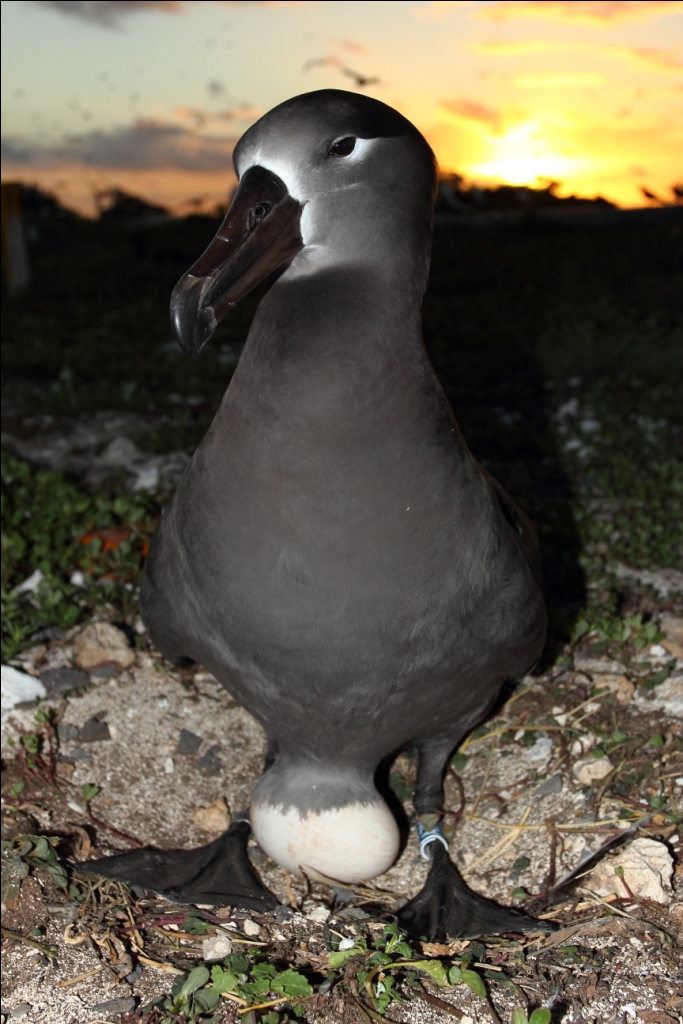
Things are starting to get exciting around here, as if the giant frigatebird chicks weren’t enough, we had our first of what will soon be thousands of the most majestic seabirds land on Tern this afternoon. Gusty rain ridden squalls have been periodically rolling in from the southeast throughout the day, and since it’s our day off, we’ve been reclining around the barracks reading, writing, and eating pasta. After a photography walk around the runway a decided to test out the gym equipment before dinner. As I was leaving the warehouse/gym after 30 minutes of crunches and pushups I was greeted with a graceful silhouette all too familiar from watching birds on Monterey Bay. A Black-footed Albatross glided over the runway; nose into the wind as if it were a Boeing 747 coming in for a landing. Immediately I shouted to the barracks not far from me “BFAL! BFAL!”, the code for Black-footed Albatross. After several passes it eventually landed on the north side of the warehouse amongst juvenile Brown Boobies and Brown Noddies. This was the first time I’d ever seen an albatross on land, the first time Larry and Olivia had ever seen an albatross outside of pictures and museum preps, and as expected it looked pretty awkward out of its element. It walked like an old hunched over man with arms clasped behind back, head bobbing with disapproval from side to side.  According to the records this particular bird with a yellow field readable band C392 was banded here on Tern Island as a chick in 1994, about the same time I was taking my first science class in my fourth year of elementary school. Cool. Our first BFAL will come and go for the next few weeks until more birds show up in November. If this season is a success, there will likely be around 2,500 BFAL and 1,500 Laysan Albatross breeding pairs by Christmas. Let the season begin.

Saturday, October 20, 2012

Welcome to Tern


I have made it to Tern. After four long days on the Kahana, fighting a cold, catching tuna, and scanning the ocean for rare seabirds, we finally anchored inside the crescent moon shaped atoll of French Frigate Shoals. I awoke to the sight of La Perouse, a pinnacle of rock in the middle of the shoal, standing tall as the red sun rose from behind a blue horizon. Morgan and I hopped off the Kahana onto a RHIB (Rigid hull inflatable boat) and disembarked at the landing dock on the southwest end of Tern. A small fixed crane aided in the loading and unloading of heavy gear, although the Kona winds were making the landing a bit hairier than normal. A string on juvenile masked boobies swung back and forth on the boom as large white pallet tubs full of the summer crew’s trash and personal items were loaded onto the RHIB. It took many trips to the Kahana and many hours to finish the landing by midday.

There is so much to say about the island and what I’ve experienced thus far, but I have little energy to type. So instead I’ll give a brief history of Tern Island based on Pamela Fiersnon’s book “The Last Atoll”.

French Frigate Shoals is a crescent shaped rim of reef, a sinking atoll formed as the ancient volcanic island beneath it dives into the tropical Pacific. It’s literally as remote as you can get in this ocean, roughly 2,000 miles from the nearest continent and 500 miles from Honolulu on the main Hawaiian Island of Oahu. Tern Island itself is an artificial stretch of land that supports a dense and varied swatch of marine life, from around 16 species of seabirds to a single highly endangered species of seal.

On November 6th 1786, a French explorer by the name Jean Francois de Galaup aboard the frigate La Perouse had an unexpected encounter with the reefs of an unnamed and uncharted shoal. He and another frigate were en route to Macoa from of all places my home away from home Monterey California with a shipment of fur seal pelts when they came upon breaking waves in the dead of night. Within minutes his experienced crew and that of the second frigate managed to about face and avoid the jagged teeth of the shallow reefs without wrecking into the history books, leaving only the name “Basse de Fregates Francaises”, meaning the Shoals of the French Frigates in their wakes.

The newly named French Frigate Shoals remained off the radar for many decades until it was re-discovered in 1858 by a US schooner, and claimed as US Territory under the Guano Act of 1856. Guano was an important source of fertilizer and was heavily harvested in those days, a similar history to the Farallon Islands and many other bird crap laden rocks throughout the Pacific.

As tensions between Japan and the US intensified in the early 1930’s, the US began conducting military training exercises in the placid semi lagoon of French Frigate in preparation for a pending conflict. They would fly seaplanes 586 miles from Honolulu since there were no large islands within the shoals to land on. Eventually a major airstrip and community was erected on Midway Atoll further down the island chain, but fighter planes were unable make the long flight from Honolulu to the newly established base at Midway. Thus in 1943 the 53 acre Tern Island was born out of compacted crushed coral and sand, to serve as a refueling point for planes destined for Midway. Shaped like a large aircraft carrier, the island’s sole function was that of a runway, no birds were allowed to nest and no vegetation allowed to take root throughout the duration of World War II.

After the War had ended Tern Island, again like many other abandoned military islands, was handed over to the US Coast Guard. They occupied the island for several decades, and tried as best they could to maintain a normal life in the middle of nowhere, complete with dogs for moral and a tennis court for exercise. Despite these amities it’s rumored that a man hanged himself from boredom in the barracks I now live in, and his ghost still haunts the long corridors at night. It seems every island has its ghost stories.

Eventually the Coast Guard willingly forfeited possession of Tern Island to the US Fish and Wildlife Service, who now serve of the active stewards of the island. Much has changed since those early days, as vegetation and seabirds they support have slowly taken over this precious oasis in a desert of blue.  Most of the seabirds out here rely on a native shrub called Naupaka for nesting habitat, a shrub that has not yet established itself on Tern. Tournefortia (if I’m spelling it correctly) however, a similar shrub not native to Hawaii but of which is found throughout the tropical Pacific, has established in place of Naupaka. Its rigid limbs and woolly broad leaves provide a critical substrate for seabirds to lay an egg on. Different seabirds use the plant in various ways. Frigatebirds at the very top and boobies a layer below build rudimentary nest platforms of collected sticks and guano atop the shrubs canopy, White Terns and Black Noddies lay their eggs on the branches within the shrub, and Christmas Shearwaters and Red-tailed Tropicbirds nest on the ground at the plants shady base. Although traditionally burrow nesters, Wedge-tailed Shearwaters will occasionally lay their egg beneath a heavy branch and in a dense shady patch of Tournefortia. Without this shrub, about 10 feet in circumference and 6 feet high, these birds would not be successful on Tern. It’s amazing what a little vegetation will do to spruce up and diversify a community.

The barracks left behind now serve as critical habitat for the researchers that inhabit this island year round. The building itself, split into two parallel hallways and one main living area, contain roughly 15 personal rooms, several offices, at least three bathrooms I have found so far, a large kitchen and pantry, storage for scientific gear, a shoe room, a patio, a shade house for native plant propagation, and a large recreation room complete with couches, 2 pool tables, a ping pong and foosball table, and a wide selection of books and movies. There’s also sheds for stowing boats and tractors, a warehouse with tools and construction material, and a large gym with weights and workout videos. The tennis court has been converted to a catchment pad for drinking water stored in aging redwood tanks, while large solar panels and a decent bank of batteries provide (in theory) electricity. We eat mainly canned food, and have enough rice, flower, and butter to keep us alive when our supply of Poptarts runs low. My room has a view of the ocean and is often coated with a film of salty air. Hopefully my computer survives the winter, if not Mom now you know what I want for Christmas.

Should be an interesting 5 months indeed – stay tuned.

Friday, October 12, 2012

Bonin Cloud


After a long night of reluctantly drinking tequila shots that were generously supplied to us by the crew of our transport vessel the Kahana, and playing several rounds of foosball at the “All Hands” bar just down the street, I awoke to a predictably cloudy head. Luckily a managed to hold down some eggs and bacon for breakfast, and after a mug of coffee and a dip in the lagoon, I was ready to start the day. Honestly most of my morning was spent napping.

Later in the afternoon I rode my bike around a few new stretches of Midway I hadn’t seen yet. I spotted about a dozen manta rays doing loops and back flips in the main harbor, feeding on tiny plankton and larvae. They had roughly six foot wingspans, not the big mantas most are familiar with, but a smaller variety I’ve seen both in Baja and Costa Rica. I photographed the Pacific-golden Plovers and Bristle-thighed Curlews, and went on a quick hike through the pine forest to enjoy the White Terns and Brown Noodys some more. Just before dinner we checked out turtle beach and found 10-15 Green Sea Turtles basking in the sun on the sand, and watched the Kahana leave the harbor on its way to Kure Atoll 60 miles northwest of Midway.

The highlight of the day was actually the day’s end. Royce and Corey (both going to Laysan) and Morgan and I (both going to Tern) rode to the end of the old runway to a northwest point called Rusty Can. Just before the sun began its rapid descent below the horizon, small black shapes started to appear from beyond the reef, occasionally arching high above the turquoise water. This is what we had been waiting for, the nightly arrival of thousands of small seabirds called petrels. Petrels, like their relatives the albatrosses, shearwaters, and storm-petrels, spend all of their time and indeed a majority of their lives out in the open ocean. Making a living on fish and squid and sleeping on the water, they fly great distances across a featureless ocean; only returning to these remote atolls for the necessary task of finding a mate and laying an egg. These are Bonin Petrels that breed on Midway, and they number in the thousands, if not hundreds of thousands. As night falls the sky becomes clotted with petrels, their calls which remind me of the sound your stomach makes when you’re hungry, fill the island with the vibrant commotion of life. Once the petrels locate their burrows and identify their mates, the calls diminish, so the best time to view this nightly phenomenon is just after sunset. We used to travel 50 miles offshore on 12 hour pelagic bird trips in Monterey hoping to spot a brief glimpse of these birds, and here they’re so thick that we had to dodge at least a half dozen resting on the roads.  Amazing. I’m told there is a smaller population of Bonin Petrels on Tern, but I’m glad I had the chance to witness these birds here on Midway.


Midway Across the Pacific


I’m typing this while lying on a double bed in an air conditioned room at the Charlie Hotel, on a remote atoll midway between California and Tokyo, appropriately named Midway Atoll. I can hear cockroaches rummaging through the garbage bin by the sink and thousands of Bonin Petrels calling from outside my window, as night takes over the street light free neighborhood. I just had one of those moments when I closed my eyes and wondered how the hell I ended up out in the middle of nowhere, in a setting as bizarre and unique as this. I finally made it to the Northwest Hawaiian Islands, a place I’ve also wanted to visit ever since reading Carl Safina’s Eye of the Albatross. Here is my synopsis of the first day.

Boarded a fancy G2 private jet around 7am, and left Honolulu and the famous Diamond Head behind us as we pierced the clouds. The plane was as smooth as butter in the air, with two couches facing the aisle and six bucket seats arranged in a non-traditional pattern towards the back. We were free to move around the cabin and could help ourselves to the snake bar and drinks (no alcohol of course). It was awesome to say the least, not sure I will ever fly in such style again. En route to Midway we followed the Papahanaumokuakea National Monument and flew over Oahu, Kauai, Nihoa, French Frigate Shoals (my soon to be home), what we thought was the shallow reef of Brook’s Bank, Laysan Island, Pearl and Hermes Atoll, and finally landed on the runway of Midway Atoll 2 hours and 45 minutes later. Aside from our ears popping and the blue ocean out the windows it was hard to notice we were flying 40000 feet up in a jet.

Once we landed hundreds of Brown Noodys and White Terns greeted us as we taxed to the hanger, where we disembarked and hopped onto limo-sized golf carts, passing by the power plant, greenhouse, and welcome to Midway sign. We were given an orientation and our rooms at the Charlie Hotel, and breaked for lunch. I was so excited to explore the island, but hungry enough to wait until after eating. 
 
After lunch, the fragmented Tern and complete Laysan team headed out on a bike tour around the island. We each get our own bike during our three day stay. The sheer beauty of this place is almost overwhelming. White Terns flutter around everywhere we look, perched in the trees and lazily flying in a lofty pattern overhead. Brown Noodys grunted at us as we passed their adult sized fledglings, occasionally swooping gingerly, although nothing compared to the aggressive assaults of the Western Gulls on the Farallones. White-tailed tropic bird chicks were crotched beneath walkways and low branches, and Great Frigatebirds chased Masked Boobies above the tree line. We even came upon a few Wedge-tailed Sheartwater chicks still in their downy stage sitting in the sun at their burrow entrances. In terms of shorebirds, Pacific Golden Plovers with their handsome yellow tinted heads, Ruddy Turnstones, and Bristle-thighed Curlews gave out alert calls as we rode past flocks of them on the roads. We even came across a few Laysan Ducks which were introduced to Midway from Laysan and seem to be flourishing here. It’s too early for Albatross, but in a few months the landscape will become overrun with thousands of Laysan, Black-footed, and if their lucky a few Short-tailed Albatross. The only albatrosses we’ve seen are the Short-tailed decoys on the hill and many plastic-filled carcasses of chicks that never made it the fledging.

We finished the day with a swim in the lagoon, which was slightly cooler than Oahu but all the more refreshing. The water is so green in the inner lagoon that the puffy clouds overhead turn turquoise in the reflection. I’ve never seen anything like it, and it’s only day one. Can’t believe this is going to be my life for the next 6 months.

Friday, September 28, 2012

Arrived in Honolulu


Hawaiian Archipelago. Main Hawaiian Islands on the right with a chain of
atolls extending to the northwest from Kauai, Tern Is roughly midway from
Midway in French Frigate Shoals.
After a rather painful two hour delay at LAX, and a relatively brief five hour flight halfway across the Pacific, I now sit on standby at the Fish & Wildlife Service bunkhouse (recently changed to the more friendly sounding ‘guest house’) in Honolulu on the Hawaiian Island of Oahu. I share the house with the refuge manager of Tern Island (my soon to be home), fellow Tern Island volunteer, and four other volunteers that will be working on Laysan Island, another atoll further down the Northwest Hawaiian Island chain. We’re essentially going to be marooned on Tern for six months, with no visitation from any boats during our stay (aside from a possible visit from the US Coast Guard). To prepare for our adventure, we’ve been sorting out how much of what kinds of food six people require for 180 days with no fresh provisions; a daunting task to say the least. On top of this is our limited budget, forcing us to omit luxury items like bacon, lunch meat, and candy for essential items like canned chicken, butter, and a whole lot of flour. So far we’ve spent around 2,500 dollars with a remaining 1,500 to spare. Not much when you think about the price of food these days, especially on a remote island. This will be a huge difference from the food we received on the Farallones; where we would spend roughly 1,500 dollars every two weeks on fresh, tasty, healthy food. Eating at Tern will be all about protein and survival rather than splurging on quinoa and pecan pie.
 The past few days have are filled with packing food, drinking coffee, and getting in a morning and evening surf at Waikiki when I can. The water here is so amazingly warm and beautiful, if it wasn’t for the sheen of coconut sunscreen from all the tourists (literally it burns your eyes) this place truly would be paradise. Thanks to a hurricane off Mexico and the south swell it’s throwing at the islands, Waikiki has been producing clean chest to head high long rides; and thanks to Illana ( a former Farallon volunteer who lives in Honolulu) generously offering me her surfboard, I can enjoy these waves until my flight to Midway in a couple weeks. This morning’s surf was particularly scenic, with white lofty tropic birds buoyantly cruising overhead, green sea turtles raising their heads for a breath, and a golden sunrise beaming through a morning shower on the jagged volcanic cliffs of the interior. I won’t be allowed to surf on Tern, so I’m trying to fit in as much board time as I can, while still helping with all the necessary work of packing.

Shipping containers containing our food.

Saturday, June 2, 2012

As the Season Progresses

Through the partially opened windows of a blind I watch a misty morning fog whip across a colony of murres at Sea Lion Cove (SLC). Clutched to the ground and huddled tight, feathers ruffled in the cool salty breeze, several hundred Common Murres sit and incubate their mint green speckled eggs. Unable to leave these eggs unattended, they endure the persistent abuse of harsh spring winds and the occasional plastering of chalky pink uric acid (bird shit) from their neighbors above. Although some colonies on the island have already begun hatching chicks, the SLC birds have several weeks ahead before incubation ends and the duties of chick rearing begin.


Fringing the clustered patches of murres are Brandt’s Cormorants atop large nest bowls of woven dry Farallon Weed and algae. The early efforts of displaying males have paid off, as they now have switched gears and share the role of incubating a clutch of up to five eggs with their mates. Like the murres, it is early yet for the arrival of chicks, with some late males still flashing their brilliant blue gular pouches and setting up nests by stealing material from adjacent birds.


Western Gulls are reaching a new level of aggression as their chicks begin to emerge. The sheer volume and frequency of their combined screams render it virtually impossible for rational thought, as if our IQ immediately drops substantially upon exiting the relative peaceful calm of the house. Simply calling them loud would be a grouse understatement. Coupled with the acoustic trauma of their calls are the physical attacks. One most always wear a helmet when walking about the island now, for the solid yellow beaks and dive bomb swoops will surely draw blood to the unprotected cranium.  A few days back while attaching a temporary band to the tarsus of a freshly hatched gull chick, I was continuously swooped by the angry parent overhead; my helmet nearly knocked away by the force of the birds impacts. This will become a common occurrence as the season progresses and more chicks break free of their calcite encasements.

Saturday, May 26, 2012

The Gannet is Back

Every so often if you’re observant enough life will present you with lessons to learn from. For example it is important when working in the field or traveling around interesting locations to always have ones camera ready for the unexpected. I have been observant enough in my experiences to recognize this lesson; however I seem to have failed to learn from it.  A few days back, during my routine evening Common Murre resighting at North Landing, I missed a unique opportunity to photograph a very lost and likely confused seabird. After spending just over an hour staring through a scope at murres incubating their eggs, a decided to take a break and do some initial tripod setup for photographing the stars later that night. My goal was to get the islets of Fisherman’s Bay and the North Star Polaris in frame and leave the camera out for 2 hours while shooting continuous 30 second exposures, to capture the rings of star trails around the northern point of the sky. As I was framing the shot and working out the best focus, Western Gulls which are now setting on eggs of their own, began giving out warning calls. They persistently scream at us whenever we walk down the paths and give out a high pitched repetitive shriek when they’re threatened, so I looked up expecting of seeing a Peregrine Falcon pursuing a helpless victim. Instead a saw a large white bird with black wing tips and a pale yellow head hovering above me. It took me a few seconds of disbelief before whispering to myself…”the Gannet!”. There it was, a Northern Gannet, a bird that should be hunting fish off the Eastern Seaboard, was holding stationary in the wind a few meters above my head. I happened to have my camera in hand, pointed it up at the bird, pressed the shutter release, heard the click of the shutter, pressed review to check the exposure, and read the following words “ERROR NO MEMORY CARD” on the LCD screen. Here was my one chance to photograph this highly unusual once in a lifetime sighting of a misplaced bird on the Farallones, and I had no memory to record it. Blast. This has happened to me on many occasions, American Oystercatchers in Baja, Yellow Nosed Albatross in Australia, Little Penguins in New Zealand, so I wasn’t surprised to be greeted with the error message again. I ran back to the house to grab a card, yelling ‘NORTHERN GANNET IS BACK’ to Ryan and Emma as I passed them by, but by time a had made it back to North Landing the bird was nowhere to be seen. Oh well, at least I still had enough memory space in my brain to see it again, and this time close enough to look it straight in the eye.

 Fortunately my plan to photograph the stars moving around Polaris (well the earth spinning in such a way that the stars appear to move around Polaris from our perspective) was a success. The photo is looking across Fisherman’s Bay at the most scenic cluster of islets and SE Farallon, from left to right: Aulon Islet, Arch Rock, Chocolate Chip, and Sugar Loaf.

Aside from unobstructed views of the night sky, this has actuallybeen an interesting month for celestial events. We witnessed a partial annular eclipse on May 20th just before sunset. I had been watching the fog moving in and out throughout the day, and I was worried it would block our chances of seeing the eclipse, but actually it worked as a natural filter and made it easier to view. I set up a tripod and my long lens with a piece of welder’s glass tapped to the objective end to photograph the transit, and grabbed another welder’s helmet for others to look through. I was working out the exposure levels when I noticed a slight round sliver encroaching the bottom left corner of the Sun,  “It’s Happening!” I yelled as I ran for the others. We thought it wasn’t going to happen for another hour, so everyone was spread out on the island finishing up their daily tasks. Eventually everyone was alerted and we gathered to watch the entire event, beers in hands and smiles on faces. An annular eclipse is when the Moon is too far away from Earth to completely block out the Sun, instead leaving a thin ring of fire around the Moon during the climax. Our location on the Farallones was just outside the alignment for seeing a complete ring, but the crescent Sun was still impressive. On June 5th an equally impressive and rarer celestial event will take place where Venus, the second planet from our star, will pass between Earth and the Sun. With the appropriate filters, or a pinhole camera, you can watch the tiny dot of Venus track across the surface of the Sun. This only happens twice in a lifetime. The first of our lifetime was 8 years ago, with the transit in June being the last; it won’t happen again for another 243 years, so it’s worth the effort to see.

Friday, May 18, 2012

Preface: It's Late, I'm Tired

Welcome to the mad house ladies and gentleman; the breeding season has officially begun. Eggs, eggs and, hey look over there, more eggs. Western Gulls are now for the most part aggressively defending full clutches of three eggs, Common Murres are popping out their single beautifully painted green egg, Brandt’s Cormorants have constructed fair built nests with some containing the first of five eggs, and Cassin’s Auklets are hatching their first chicks of potentially two broods. All of these eggs equate to many hours of sitting in wooden boxes staring through scopes; following the incubation, rearing, and fledging of all breeding species for the next two months. Luckily we get a fresh shipment of coffee beans every two weeks.


Last night was a double header, diet sampling for Cassin’s Auklets and mist netting for storm-petrels. Shortly after writing the daily journal and finishing the superb chocolate java chip brownies Emma prepared for use, we downed a healthy serving of coffee and under the cover of darkness made our way to North Landing. The team and I spread out in an area retiled with Cassin’s burrows and waited for the mates coming in for their nightly change over. Birds with chicks are now flying in with crops full of krill, and our mission was to intercept ten birds to collect this bounty of crop krill. Catching them proved difficult for me anyway, but luckily one flew right into my chest and landed in my arms. Unfortunately it refused to regurgitate any krill. This data is part of a long term look at the diet of Cassin’s Auklets, and has shown interesting trends in foraging bouts by parents when the krill is plentiful (which it appears to be this year), and when it’s scarce. Aside from the impact of a hefty incoming Rhino Auklet to the cranium, the sampling went well.

Shorty after wiping the euphausiids from our coat sleeves, we trekked up Lighthouse Hill and sit up a thinly threaded net designed to catch small birds (known as a mist net) in an attempt to snag some very interesting seabirds called storm-petrels. More than half of the world’s population of Ashy Storm-petrels breeds on the Farallon Islands. They are some of the smallest true seabirds, about the size of a barn swallow, and yet are closely related and share a similar life history to albatrosses, the largest group of birds that roam the open seas. Storm-petrels are crevice nesters, returning each night to relieve the mate from incubation and rearing duties. Ashy’s lay a single egg in a protracted breeding season that generally extends from May to October. We managed to capture, weigh, measure, and band 130 birds in a 3 hour period from 11PM to 2AM; mostly consisting of Ashy’s with a handful of Least and Dark-rumped Storm Petrels. Information gleaned from this long term banding data set has shown that Ashy’s can live to be at least 30 years of age, likely longer. Storm-petrels are fascinating birds that we know relatively little about…possible graduate work?