Saturday, February 28, 2015
Kayak-cicles: Day 93
Remnants of freezing rain growing on the underside of my kayak. Although slushy snow and abundant sunshine give the illusion that spring is just around the corner, I don't think I will be going for a paddle anytime soon.
Canon EOS 60D, Canon EF 17-40mm f/4L USM, ISO-400 f/8 @ 1/500 sec.
Friday, February 27, 2015
Back On The Trail: Day 92
Yesterday I took Reef on his first trail walk since he tweaked his back a few weeks ago. He was so eager to check out every bend in the path that he became very impatient whenever I paused to listen for birds, as in this photo. His excitement peaked when we were passed by four dog sled teams enjoying the warmer weather. As they flew by Reef gave me the "What the hell was that ?" look, and then proceeded to charge up and down the trail like a maniac. Time to break out the pain killers again.
Canon EOS 60D, Canon EF 70-200mm f/4L USM + 1.4x, ISO-400 f/5.6 @ 1/1000 sec.
Thursday, February 26, 2015
Catkins: Day 91
These are seed bearing catkins from an Alaska Birch (Betula neoalaskana), illuminated by our now brilliant morning light. Redpols in particular thrive on birch catkins, littering the white forest floor with brown seed casings as they swarm through the canopy.
Canon EOS 60D, Canon EF 17-40mm f/4L USM + Canon EF 25mm Extension Tube II. ISO-800 f/5 @ 1/100 sec.
Wednesday, February 25, 2015
Cloudy With A Chance Of Aurora: Day 90
Solar wind is once brushing past earth's atmosphere, however cloudy snow laden skies are obscuring our view of the lights here in Fairbanks. Luckily I have plenty of photos from the last big three-night show.
Canon EOS 60D, Canon EF 17-40mm f/4L USM, ISO-1250 f/4 @ 20 sec.
Tuesday, February 24, 2015
Freezing Rain: Day 89
These are strange times for weather up here near the arctic. A persistent high pressure ridge continues to loom over the North Pacific, bringing severe drought to the west and significantly warmer temperatures to Alaska. So warm in fact that it rained this past weekend in Fairbanks, during what should be the coldest month of the year. It's snowing again this morning, but with temperatures just barely below freezing, this new snow is at risk of becoming another layer of ice.
Canon EOS 60D, Canon EF 70-200mm f/4L USM + 1.4x, ISO-800 f/5.6 @ 1/500 sec.
Monday, February 23, 2015
Back To The Banks: Day 88
Juneau: It was fun while it lasted.
Canon EOS 60D, Canon EF 17-40mm f/4L USM, ISO-400 f/11 @ 1/250 sec.
Sunday, February 22, 2015
Ice Cave: Day 87
We discovered a massive ice cave on our hike to Mendenhall Glacier.
Canon EOS 60D, Canon EF 17-40mm f/4L USM, ISO-400 f/7.1 @ 1/1250 sec.
Saturday, February 21, 2015
Mendenhall Glacier: Day 86
Glaciers are the form of ice we are glad to see on our brief vacation from frozen water. This is Mendenhall Glacier, located just outside of the state's humble capital of Juneau in Southeast Alaska.
Canon EOS 60D, Canon EF 70-200mm f/4L USM + 1.4x, ISO-200 f/13 @ 1/320 sec.
Friday, February 20, 2015
Southeast: Day 85
Feels good to be by the ocean again, if only temporarily.
Canon EOS 60D, Canon EF 17-40mm f/4L USM, ISO-400 f/14 @ 1/250 sec.
Thursday, February 19, 2015
Better Than Fireworks: Day 84
The only things missing from this photo are a bowl of popcorn and beer... and maybe some friends. Aurora borealis: the greatest show on earth. I just can't get enough of it. Temperatures have warmed up significantly, almost positive 40° F in the hills during the day, which makes lounging along the side of a summit pass road in the middle of the night pretty easy. Especially when the lights are as good as they've been the past few nights.
Canon EOS 60D, Canon 17-40mm f/4L USM, ISO-1000 f/4 @ 15 sec.
Wednesday, February 18, 2015
Multicolored Aurora: Day 83
Our planet is currently passing through a river of solar wind that is spewing from a gaping hole in the sun, lighting up the northern skies with dazzling displays of aurora over the past few nights. While we could only see long curtains of green with subtle pinks, my camera set to a high ISO and long shutter speed revealed a rainbow of hidden colors. The geomagnetic storms were so strong my camera picked up multicolored displays of pinks, reds, and purples. Forecasters are calling for the auroras to continue into tomorrow morning for those living in higher latitudes.
Canon EOS 60D, Canon EF 17-40mm f/4L USM, ISO-2500 f/4 @ 20 sec.
Tuesday, February 17, 2015
Yukon Quest Arrives: Day 82
There we stood peering into the woods, at the terminus of a 1,000 mile long historic trail, waiting with anticipation. The first two dog sled teams of the annual Yukon Quest, the front-runner Brent Sass with Allen Moore in close pursuit, finally arrived in Fairbanks late last night after a grueling ten day competition. The Yukon Quest is an international dog sled race developed by local mushers who wanted to honor the Yukon River, a frozen"highway to the north" that allowed passage to the famed Klondike goldfields during the early 1900's. A total of 25 teams left Whitehorse Canada on February 7th, and have endured frigid sub-zero temperatures, piercing high winds, long nights, and even a charging bull moose. Yesterday, Casey and I drove up Chena Hotsprings Road to a trail crossing to catch a glimpse of the teams on their final 45 mile leg to Fairbanks. Sass held a commanding lead for most of the race, as much as ten hours ahead at one point, but overslept by nine hours on the trail and found himself two minutes behind Moore at the Two Rivers checkpoint. Moore and his 13 dogs (pictured here) were a mere minute or so behind Sass when they passed us, but in the end Sass regained a comfortable lead and took first place; arriving in Fairbanks along the Chena River around 10:52 pm last night.
Check out live tracking of the race HERE as the final mushers make their way to the finish line.
Canon EOS 60D, Canon EF 70-200mm f/4L USM + 1.4x, ISO-6400 f/5.6 @ 1/320 sec.
Monday, February 16, 2015
Open Space: Day 81
High winds atop Murphy Dome keep these weathered granite plutons free of snow and exposed to the elements.
Canon EOS 60D, Canon EF 17-40mm f/4L USM, ISO-800 f/20 @ 1/250 sec.
Sunday, February 15, 2015
City Lights: Day 80
Despite the bright lights of Fairbanks and a full moon night, the aurora shows through.
Canon EOS 60D, Canon EF 17-40mm f/4L USM, ISO-400 f/4 @ 8 sec.
Saturday, February 14, 2015
Some Sap: Day 79
I took this picture last year as part of a collaborative gift to a friend, and it seems appropriate for today's post.
Canon EOS 60D, Bower 8mm f/3.5 Fisheye CS, ISO-1600 f/3.5 @ 1/40 sec.
Friday, February 13, 2015
He's Not A Kid Anymore: Day 78
Good news: Reef's joints, bones, and teeth all look great for a dog his age. Bad news: x-rays are not cheap. With the recent cold snaps, Reef has been wearing fleece booties to keep his paws warm on our daily walks. Naturally he hates them. So when it warmed up enough for a booty-less walk the other day, Reef went berserk in the snow and ran full speed down our back road. A few hours later his age caught up with him. He did not want to put much weight on his hind legs and refused to climb any stairs. I think it might be the first time I've heard him whimper...ever. Well except for that one time I slammed his tail in the car door. Long story short I took him to the vet and he gave a strong reaction to pressure being applied to his lower spine - he nearly bit the vet's head off. X-rays revealed very little-to-no arthritis growth or signs of a torn tendon, but did show a possible swelling of the disk between the L7 (lumbar) vertebra and the sacrum (the space just after the fifth vertebra from the left of frame). Hopefully with rest and some anti-inflammatory pills he and I can avoid the next step, an expensive visit to the MRI.
Unknown X-ray machine, ISO-I'm not sure, f/ doesn't apply, probably happened really fast.
Thursday, February 12, 2015
Redpoll: Day 77
Every morning just after sunrise, the otherwise dormant bare birch trees that surround our cabin, burst to life with the trills and flickering of redpolls. Thousands of these small energetic birds invade the forest canopy, shaking the seeds from birch catkins and stuffing them in their stretchy throat pouches. Mixed flocks of both Common and Hoary Redpolls have been around all season, but their numbers have certainly increased as winter slowly turns to spring. Amazingly these small birds can thrive in temperatures below -50° F, by increasing their insulating plumage and tunneling into the snow at night. Now wouldn't that just be an adorable sight to stumble upon, a tunnel of downy redpolls.
Canon EOS 60D, Canon EF 70-200mm f/4L USM + 1.4x, ISO-640 f/5.6 @ 1/320 sec.
Wednesday, February 11, 2015
Rat Nest: Day 76
We are back out of the negatives, it is now a whopping 1° F outside. We've discovered that when it's consistently below -15° out, our heater has a difficult time keeping up with the gaps in the insulation of our cabin, and the plumbing begins to freeze. So far our shower drain, both hot and cold shower water, and the cold water for the washing machine, have all frozen on multiple occasions. The plumbing is very narrow in diameter, so it typically only takes about 10 minutes of direct heat from a heat gun and propane space heater to clear the freeze. I am happy to report that no dead bodies were discovered under our house.
Canon EOS 60D, Bower 8mm f/3.5 Fisheye CS, ISO-1250 f/3.5 @ 1/8 sec.
Tuesday, February 10, 2015
New Yard Bird: Day 75
Stepping out into the cold to check the level of our heating oil tank, I heard from the woods what sounded like the pattering of water dripping onto a side-walk. Since liquid water doesn't exist when it's -20 outside, and we have no side-walks, I went to investigate. Turns out the pattering sound was actually a male Three-toed Woodpecker. distinguishable from other woodpeckers by the yellow crown and barred white back, chipping away at the bark of a dead spruce. A new species for our yard and for my life list in general. Similar to the Boreal Owl, Three-toed Woodpeckers reside in the boreal forests of the far north, throughout the Canadian Arctic from Alaska to Newfoundland; dipping further south only along the Rocky Mountains. Feeding mainly on wood boring beetle larvae, these woodpeckers may be the best defense against the spruce bark beetle, a destructive invasive from Europe that has devastated an estimated 3 billion board feet of timber in Alaska alone; including the spruce in this photo. This particular bird had no problem with Reef, Casey, and myself standing at the base of tree watching it feed, so I'm guessing the feeding was good.
Canon EOS 60D, Canon EF 70-200mm f/4L USM + 1.4x, ISO-1000 f/5.6 @ 1/200 sec.
Sunday, February 8, 2015
Octohip: Day 74
It might be a sign that I've been deprived of the ocean for too long when a shriveled up wild rose hip reminds me of an octopus. What do you think? I don't own a macro lens, so for this shot I used a hollow 25mm extension tube, which essentially turns any lens into a macro lens by moving it 25mm further away from the camera sensor. This enables the lens to focus at a closer distance, thus increasing the magnification of the subject. Extension tubes are a cheap alternative to true macro lenses, and can yield equally satisfactory results.
Canon EOS 60D, Canon EF 17-40mm f/4L USM + Canon EF 25mm Extension Tube II , ISO-400 f/9 @ 1/20 sec.
SEM: Day 73
Casey has been learning how to use a scanning electron microscope (SEM), and yesterday he gave me a quick rundown on the process. SEM's differ from traditional optical microscopes in that they use a focused beam of electrons, rather than light, to image a specimen. Achieving a much higher resolution than optical scopes, some SEM's can create a detailed image of a strand of DNA 2 nanometers in diameter. Just for scale a sheet of paper is 100,000 nanometers thick. That's pretty incredible. The only caveat is the specimen must first be coated in gold before electrons are hurled at it. Read more about this amazing tool HERE on Casey's blog.
Canon EOS 60D, Canon EF 17-40mm f/4L USM, ISO-1000 f/4 @ 1/40 sec.
Saturday, February 7, 2015
Aurora Selfie: Day 72
Science and technology have taken the guessing out of aurora watching. Satellites that monitor the sun's geomagnetic activity can predict with reliable accuracy when solar winds are bound to strike earth's atmosphere. There's even a new webcam, maintained by the Geophysical Institute at UAF, that allows viewers to see in real-time when the aurora is active. The link is HERE. We noticed last night before going to bed that the northern lights were putting on a show just after the moonrise, but I'm still playing catch-up with previous night's photos, and it was negative twenty out, so we stayed in bed.
Canon EOS 60D, Canon EF 17-40mm f/4L USM, ISO-400 f/4 @ 4 sec.
Friday, February 6, 2015
Classic Reef: Day 71
This is basically what Reef does all day when it's below zero out, and I'm pretty sure he's okay with that.
Canon EOS 60D, Canon EF 85mm USM, ISO-800 f/1.8 @ 1/60 sec.
Thursday, February 5, 2015
Ice Roads: Day 70
Canon EOS 60D, Canon EF 70-200mm f/4L USM + 1.4x, ISO-800 f/20 @ 1/500 sec.
Wednesday, February 4, 2015
Snow Moon: Day 69
This month's full moon is called the "Snow Moon", since February tends to be the coldest snowiest month of the year. This might be true for the east coast right now, but not so much for the drought stricken west. There's no snow any time soon in the forecast for Fairbanks either, but temperatures are staying in the negative teens and twenties, with another cold snap bringing negative thirties by the weekend.
Canon EOS 60D, Canon EF 17-40mm f/4L USM, ISO-800 f/4 2.5 sec.
Tuesday, February 3, 2015
Alaska Railroad: Day 68
A few days back we took a drive to the park boundary of Denali to escape the flat monotony of the Tanana Valley. The park itself is closed to motorists in the winter, and the closer you get to the actual mountain of Denali the more obscured it becomes, but the surrounding rocky peaks were just as spectacular. Heading back home we were lucky to catch up with the Aurora Winter Train, which only operates on the weekends between Fairbanks and Anchorage. A 12 hour trip that runs northbound on Saturday and southbound on Sunday.
Canon EOS 60D, Canon EF 17-40mm f/4L USM, ISO-800 f/16 @ 1/500 sec.
Monday, February 2, 2015
Thank You Sun Spots: Day 67
Gusty solar winds brushed past the earth's magnetosphere once again last night, producing another awesome showing of northern lights. Kp levels peaked at 5, otherwise considered a G1 (minor) class storm. The high end of the geomagnetic scale is a G5. Such a storm would have the potential to cause widespread power outages, damage transformers, cause navigational issues for aircraft and wildlife, and disrupt radio and satellite communications; but these rarely happen. The only thing damaged by last night's G1 storm was my sleep pattern.
Canon EOS 60D, Canon EF 17-40mm f/4L USM, ISO-320 f/4 @ 8 sec.
Sunday, February 1, 2015
The Lights Continue: Day 66
A geomagnetic storm finally arrived just around midnight last night, producing brilliant displays of aurora overhead. This is a photo of me getting home from watching it around 1 am this morning. Today, Casey and I are going on a scenic drive to celebrate 3 years as a couple, Reef's coming too. Hopefully the "Big Game" will give us the road all to ourselves.
Canon EOS 60D, Canon EF 17-40mm f/4L USM, ISO-640 f/4 @ 8 sec.
Saturday, January 31, 2015
Down the Rabbit Hole: Day 65
I was driving around yesterday scoping out potential vistas for photographing a predicted geomagnetic storm set to arrive this weekend, when I came across a pretty spectacular view of Fairbanks back-lit by the sun. The sun's angle made the smoke and steam emanating from the buildings below really pop, so I took some pictures and stitched them into a panorama. My plan was to distort the image into another tiny world, but Casey had the bright idea of creating an atmosphere wrapped by the landscape instead. The outcome I think is pretty cool, and fits with the theme of the photo; a positive feedback loop of human pollution trapped within a winter bubble.
Canon EOS 60D, Canon EF 70-200mm f/4L USM + 1.4x, ISO-200 f/20 @ 1/500 sec, 9 image panorama
Friday, January 30, 2015
Unhealthy Air: Day 64
Burning wood is a cheap, cozy form of heating during the frigid winter months here in Fairbanks. Nothing says "Alaska" like grabbing a few logs from the woodpile outside in your flannel long-johns, and tossing them on the old fire. While wood stoves are nice to sit around on a cold night, the accumulated smoke they exhaust out the chimney is literally making the air we breath up here unbearably toxic. When temperatures fall below zero, a strong inversion layer grips the low lying valley of Fairbanks, creating a thick ceiling that traps tiny particles of exhaust and smoke (referred to as PM-2.5) suspended in the air. Like a silent plague, a dense cloud settles into the city of Fairbanks. It's not just unpleasant, it's a hazard. PM-2.5 stands for Particulate Matter that is 2.5 microns or less in width, small enough to pass through the lungs and into the bloodstream. Inhale enough of this stuff and symptoms can range from a cough and respiratory irritation to asthma and heart disease. The situation can be so bad in winter that in some years air quality in this modest town of 32,000 is worse than Beijing; a city with over 12 million people. Kind of puts a damper on the old ambiance of the fire, no pun intended. Fortunately Casey and I live up in the hills, high above the inversion layer and the ice fog of death.
Canon EOS 60D, Canon EF 70-200mm f/4L USM + 1.4x, ISO-200 f/25 @ 1/500 sec.
Thursday, January 29, 2015
Late Night Hooting: Day 63
A creature has been lurking in the dark around our cabin. Although never seen, its "winnowing"call can be heard echoing through the forest on cold clear nights. No it's not Big Foot, he sleeps at the foot of our bed, it's the Boreal Owl (Aegolius funereus). These small secretive owls are residents of the boreal and sub-alpine forests of the far north, with a circumpolar range that extends into the Rockies. Their cryptic lifestyle and difficult habitat makes them one of the least known species of owl in North America. The call we've been hearing (SOUNDS), as iconic to the arctic winter night as a robin's call is to an English summer day, is the male attempting to attract a female. Boreal owls nest in tree cavities excavated by woodpeckers. During the winter males seek out and defend these nesting cavities in hopes of enticing a mate. Once a pair has been established, in the spring females will lay up to six eggs with an incubation period of about one month. We've been hearing a male regularly calling all winter in the trees just outside our cabin, and since nesting cavities can be in high demand, I built an owl box and placed it high in a tree within viewing distance of our living room window. Hopefully by spring we'll have ourselves a pair of owls, and by summer a brood of awkward boreal owl fledglings.
Here's a cool video of a boreal owl hunting: VIDEO
Canon EOS 60D, Canon EF 70-200mm f/4L USM + 1.4x, ISO-100 f/22 @ 1/4 sec.
Wednesday, January 28, 2015
Aurora Continues: Day 62
A second night of aurora watching. This time I put hand warmers in my socks and wore five layers of pants instead of four. Displays were more subtle than the previous night, and the moon is gaining intensity, so here's another photo of the big showing from the 26th.
Canon EOS 60D, Canon EF 17-40mm f/4L USM, ISO-800 f/4 @ 8 sec.
Tuesday, January 27, 2015
Surprise Aurora: Day 61
Clear skies after a week of clouds made me think one thing, aurora? Conflicting forecasts, however, shed some doubt onto whether or not the northern lights would actually show itself. One website was calling for a kp of 4 (active) while others were more pessimistic in their predictions. It was cold enough yesterday, -50 F in some places, to freeze the plumbing of our shower; so needless to say I wasn't very eager to freeze my own plumbing waiting outside for something to happen. I did have an excuse to go stargazing though. A near Earth asteroid, 2004 BL86, 1,000 feet in diameter passed within 745,000 miles of our planet (roughly 3x the distance of the moon). The next near earth asteroid isn't scheduled to arrive until 2027, so this one was worth a look. I set up my camera to try and capture its course through the night sky with a long exposure, but very quickly became distracted by a dazzling display of aurora that unexpectedly emerged from the north. I guess I'll have to wait until 2027. Actually, 2004 BL86 is in this shot somewhere above and to the left of Jupiter (the bright point of light), but you can't really see it.
Canon EOS 60D, Canon EF 17-40mm f/4L USM, ISO-800 f/4 @ 8 sec
Monday, January 26, 2015
Sun Dog: Day 60
You don't need rain falling over a warm tropical island to see rainbows; freezing air works too. It is now -36 F at the Fairbanks airport and just below -20 F up in the hills. At these temperatures, all moisture in the air freezes into tiny crystals, referred to as diamond dust, that gently rain down and powder coat all surfaces with frost. This diamond dust acts like millions of randomly distributed prisms in the air, refracting the colors of the spectrum into a 22° halo around the sun. As the tiny ice crystals fall from the sky they tend to orient themselves vertically, sort of like having a bunch of falling hexagonal disks all in vertical alignment. These little ice disks flutter as they fall, and due to their orientation instead of refract, they reflect the sun's light, forming a second phenomenon called the parhelic circle; more like like an arc parallel to the horizon with the sun as the midpoint. Are you with me? Where the parhelic circle intersects the 22° halo, the refracted light from the sun is exaggerated by the combined reflection of the ice crystals, forming what are called "sun dogs". Winter's version of a rainbow. This is the left-hand sun dog pictured here, red is always facing the sun.
If that still doesn't make sense check out this link: http://spaceweather.com/images2015/25jan15/halos_labelled.jpg?PHPSESSID=bdipp77uf3trf4qfchnsf73un2
Canon EOS 60D, Canon EF 70-200mm f/4L USM +1.4x, ISO-200 f/20 @ 1/160 sec
Sunday, January 25, 2015
The Negatives: Day 59
The second major winter storm to hit Alaska this season has affected Anchorage more than Fairbanks, but it did manage to once again blanket everything here in a frosty layer of white. This system also brought in our first real cold snap of the season. As the insulating clouds parted yesterday afternoon the thermometer on our deck dropped to -10 F for the first time since we moved here. Temperatures in town drop well into the negatives all the time, but rarely does it dip below zero in the hills where we live. Forecasters expect temperatures will continue to plummet throughout the week as skies remain clear. This morning our deck thermometer is reading -20 F...probably won't be wearing a t-shirt to check the BBQ now.
Canon EOS 60D, Canon EF 17-40mm f/4L USM, ISO-100 f/22 @ 0.8 sec
Saturday, January 24, 2015
Good Dog?: Day 58
Alright, in certain lighting I can see why some people would be slightly intimidated by this dog. Especially when he does his "bull ready to charge" stance. Here, Reef is wondering why I called him out on the porch when it was negative 5 out. I wanted to get a photo of his breath in the cold, and he wanted me to stop staring at him and open the damn the door.
Canon EOS 60D, Canon EF 17-40mm f/4L USM, ISO-1000 f/4 @ 1/50 sec
Friday, January 23, 2015
FAI: Day 57
When people do finally come visit us, this is the airport you'll be flying into: the Fairbanks International Airport (FAI). The airport itself has been around since the 50's, serving as a refueling stop for transpacific flights to Europe and Asia. This shiny new terminal was completed in the fall of 2009 to meet rigorous new TSA standards. Fun fact the lowest temperature recorded from FIA was -66 F...of course now that I say that you probably won't visit anymore. We haven't felt anything nearly that cold yet this winter, but forecasters are calling for 40 below by the middle of next week.
Canon EOS 60D, Canon EF 17-40mm f/4L USM, ISO-100 f/4 @ 3.2 sec
Thursday, January 22, 2015
Still A Tourist: Day 56
There are moments during my day to day, driving with confidence on a freeway made of ice, or wearing a t-shirt when it's zero degrees outside to check the BBQ, where I almost feel like a true Alaskan. Then again there are moments like the one in this photo, seeing a giant moose just casually standing along the side of the road, which remind me that I'm still just a tourist to these parts. Heading back from the post office I ran across this mum with calf grazing ironically in a shooting range just down the road from our cabin. Of course I pulled over to take a look, and in the process received some looks of my own from people who actually behave like residents here. I felt like an Australian giddy with excitement over the sight of a ground squirrel. Sure there are thousands of moose up here, but I've only seen a handful, so for now I will continue this tourist mentality...at least when it comes to moose.
Canon EOS 60D, Canon EF 70-200mm f/4L USM + 1.4x, ISO-500 f/6.3 1/640 sec
Wednesday, January 21, 2015
Birches: Day 55
When I see birches bend to left and right
Across the lines of straighter darker trees,
I like to think some boy's been swinging them.
But swinging doesn't bend them down to stay
As ice-storms do. Often you must have seen them
Loaded with ice a sunny winter morning
After a rain. They click upon themselves
As the breeze rises, and turn many-colored
As the stir cracks and crazes their enamel.
Soon the sun's warmth makes them shed crystal shells
Shattering and avalanching on the snow-crust—
Such heaps of broken glass to sweep away
You'd think the inner dome of heaven had fallen.
They are dragged to the withered bracken by the load,
And they seem not to break; though once they are bowed
So low for long, they never right themselves:
You may see their trunks arching in the woods
Years afterwards, trailing their leaves on the ground
Like girls on hands and knees that throw their hair
Before them over their heads to dry in the sun.
But I was going to say when Truth broke in
With all her matter-of-fact about the ice-storm
I should prefer to have some boy bend them
As he went out and in to fetch the cows—
Some boy too far from town to learn baseball,
Whose only play was what he found himself,
Summer or winter, and could play alone.
One by one he subdued his father's trees
By riding them down over and over again
Until he took the stiffness out of them,
And not one but hung limp, not one was left
For him to conquer. He learned all there was
To learn about not launching out too soon
And so not carrying the tree away
Clear to the ground. He always kept his poise
To the top branches, climbing carefully
With the same pains you use to fill a cup
Up to the brim, and even above the brim.
Then he flung outward, feet first, with a swish,
Kicking his way down through the air to the ground.
So was I once myself a swinger of birches.
And so I dream of going back to be.
It's when I'm weary of considerations,
And life is too much like a pathless wood
Where your face burns and tickles with the cobwebs
Broken across it, and one eye is weeping
From a twig's having lashed across it open.
I'd like to get away from earth awhile
And then come back to it and begin over.
May no fate willfully misunderstand me
And half grant what I wish and snatch me away
Not to return. Earth's the right place for love:
I don't know where it's likely to go better.
I'd like to go by climbing a birch tree,
And climb black branches up a snow-white trunk
Toward heaven, till the tree could bear no more,
But dipped its top and set me down again.
That would be good both going and coming back.
One could do worse than be a swinger of birches.
I like to think some boy's been swinging them.
But swinging doesn't bend them down to stay
As ice-storms do. Often you must have seen them
Loaded with ice a sunny winter morning
After a rain. They click upon themselves
As the breeze rises, and turn many-colored
As the stir cracks and crazes their enamel.
Soon the sun's warmth makes them shed crystal shells
Shattering and avalanching on the snow-crust—
Such heaps of broken glass to sweep away
You'd think the inner dome of heaven had fallen.
They are dragged to the withered bracken by the load,
And they seem not to break; though once they are bowed
So low for long, they never right themselves:
You may see their trunks arching in the woods
Years afterwards, trailing their leaves on the ground
Like girls on hands and knees that throw their hair
Before them over their heads to dry in the sun.
But I was going to say when Truth broke in
With all her matter-of-fact about the ice-storm
I should prefer to have some boy bend them
As he went out and in to fetch the cows—
Some boy too far from town to learn baseball,
Whose only play was what he found himself,
Summer or winter, and could play alone.
One by one he subdued his father's trees
By riding them down over and over again
Until he took the stiffness out of them,
And not one but hung limp, not one was left
For him to conquer. He learned all there was
To learn about not launching out too soon
And so not carrying the tree away
Clear to the ground. He always kept his poise
To the top branches, climbing carefully
With the same pains you use to fill a cup
Up to the brim, and even above the brim.
Then he flung outward, feet first, with a swish,
Kicking his way down through the air to the ground.
So was I once myself a swinger of birches.
And so I dream of going back to be.
It's when I'm weary of considerations,
And life is too much like a pathless wood
Where your face burns and tickles with the cobwebs
Broken across it, and one eye is weeping
From a twig's having lashed across it open.
I'd like to get away from earth awhile
And then come back to it and begin over.
May no fate willfully misunderstand me
And half grant what I wish and snatch me away
Not to return. Earth's the right place for love:
I don't know where it's likely to go better.
I'd like to go by climbing a birch tree,
And climb black branches up a snow-white trunk
Toward heaven, till the tree could bear no more,
But dipped its top and set me down again.
That would be good both going and coming back.
One could do worse than be a swinger of birches.
Birches:
A poem by Robert Frost
Canon EOS 60D, Canon EF 70-200mm f/4L USM + 1.4x, ISO-800 f/5.6 @ 1/125 sec
Tuesday, January 20, 2015
Andromeda: Day 54
Auroral activity has been at a minimum lately, forcing me to focus my attention on other aspects of the night sky. Using a high ISO, a wide angle lens, and finding a location with no light pollution, our galaxy the Milky Way can be revealed; but what about other galaxies? Those amazing shots of nebula and other structures in deep space are generally achieved by using a telescope on a moving mount that tracks the stars as they rotate, allowing for a very long exposure. Fancy telescopes and motorized mounts are quite expensive, and not an option for an unemployed field biologist like myself.
The problem is, very few photons of light actually reach earth from distant objects in space. So a long exposure is necessary to gather enough information to produce an image. If you leave the shutter open for too long with just a fixed tripod, everything gets blurred as the earth spins. Turns out there's a free program called Deep Sky Stacker that allows the novice sky watcher to get fairly detailed images of distant objects in space using only a DSLR camera and a tripod. The basic principal is simple. For example instead of taking a single four minute (240 second) exposure on a moving mount, you can take a one second exposure on a fixed mount 240 times, align each frame so the stars stay in the same location, and stack those frames one on top of the other. With both methods the same amount of light is being absorbed by the sensor.
After several failed attempts I finally achieved this very basic image of our sister galaxy Andromeda. Andromeda and the Milky Way are both spiral galaxies, and are very similar in shape. Looking at Andromeda is like looking at a mirror. If you were to jump onto a space ship and rocket beyond the outer limits of the Milky Way for a view, this is what our home would look like. The light contained in this image, the contribution of over one trillion stars, has traveled 2.5 million light years to reach the sensor of my camera. You can even make out some detail in the dust lanes that spiral around the galaxy's dense core. I had no idea this sort of image was possible from a back yard photo shoot.
Amazingly Andromeda is currently hurling towards earth and the Milky Way at a speed of roughly 110 kilometers per second (68 miles per second). When the two galaxies eventually do collide the fate of our solar system will likely be in jeopardy. No need to worry though, at that speed it will still take Andromeda 4 billion years to get here. Life on earth will likely be long gone by then. Really puts it all into perspective.
Canon EOS 60D, Canon EF 70-200mm f/4L USM, ISO-6400 f/4 @ 265 sec (1.6 sec x 166 frames)
Monday, January 19, 2015
Ptarmagin: Day 53
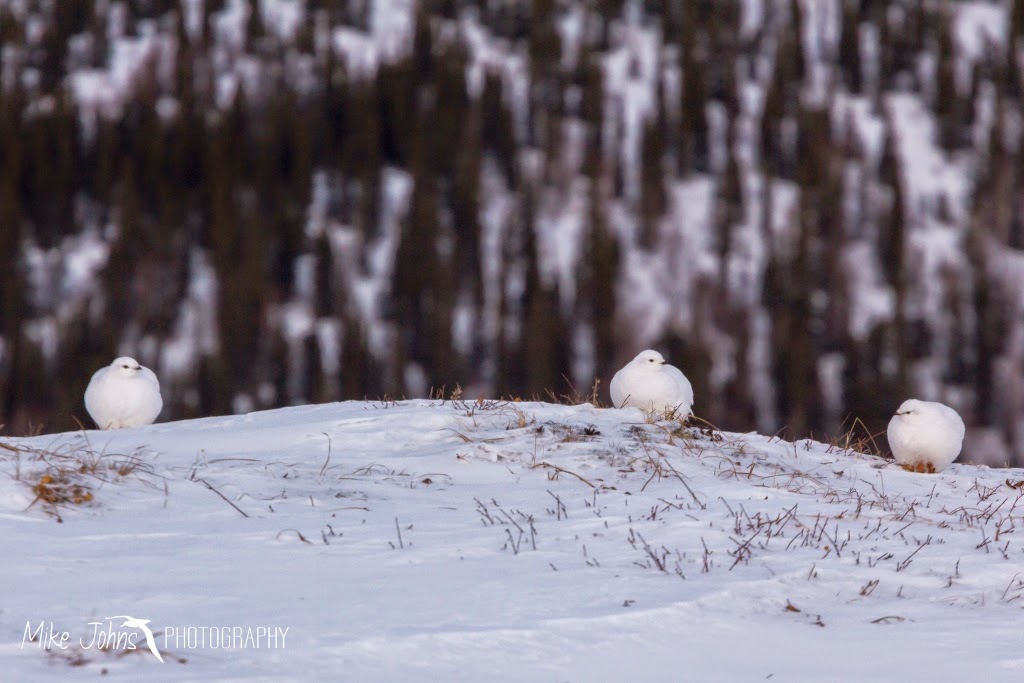
During our walk around Murphy Dome, Casey noticed a group of large round snowballs on a windswept clearing, which turned out to be a flock of ptarmigan. These are rock ptarmigan, distinguishable from willow ptarmigan by the all white winter plumage. The three birds in this photo are female. Males have a black stripe that extends from the eye to the beak. It is not uncommon to see large flocks of ptarmigan grazing on the buds of dwarf birch around open tundra in the winter. In the spring, flocks disperse as males begin defending territories and females choose a mate with the best territory. Eggs are laid in April and hatch roughly three weeks later. Virtually everything up here eats ptarmigan, including humans, so I was surprised at how easy it was to simply walk up to them for this photo.
Canon EOS 60D, Canon EF 70-200mm f/4L USM + 1.4x, ISO-800 f/8 @ 1/1000 sec
Sunday, January 18, 2015
Murphy Dome: Day 52
Checking the domes off our list. Yesterday we explored Murphy Dome, a 3,000 foot vista roughly 20 miles west of town. During the drive up a small sedan we were following, in an effort to avoid an oncoming truck, drove too far over onto the shoulder and became stuck in the snow bank. Turns out the oncoming truck was a state trooper, who pulled along side our car. Casey rolled down his window, "Did he just get stuck?". Trooper with a smirk, "Yeah he just drove right off the road". The stuck driver was a tourist from Hong Kong who explained to us that this was "his first time driving in snow". It showed. We dug out his front tires, and with some rocking, pushed the rental car back onto solid road. Alaskans: neighbors helping neighbors.
Canon EOS 60D, Canon EF 17-40mm f/4L USM, ISO-400 f/7.1 @ 1/250 sec
Saturday, January 17, 2015
The Open Road: Day 51
Thinking about exploring some new terrain this morning.
Canon EOS 60D, Canon EF 17-40mm f/4L USM, ISO-800 f/7.1 @ 1/50 sec
Friday, January 16, 2015
Star Trails: Day 50
Nearly two hours of stacked exposures reveals just how high above the horizon the north star is at this latitude. A fixed camera with a prolonged open shutter shows the stars getting dragged around a single point of light in the night sky. This is Earth's rotational axis which currently points to the star Polaris. Just like a spinning top, a slight wobble exists in Earth's rotational axis that completes a circle every 26,000 years. Polaris will one day have to step down from its status as the north star, and in 13,000 years the star Vega will begin its reign as the leader north.
Canon EOS 60D, Bower 8mm f/3.5 Fisheye CS, ISO-100 f/3.5 @ 1 hour 39 min (10sec x 594 frames)
Thursday, January 15, 2015
Morning: Day 49
The morning sun remains reluctant to advance any higher than a few degrees above the peaks of the Alaska Range. Prolonged sunrises happen often this time of year. As winter slowly progresses into spring, the sun will once again reclaim its position high in the sky, increasing the day length and reducing the window of morning and evening colors. Currently we're gaining nearly seven minutes of sunshine each day, adding up to a day-length of seven hours by the end of January. It appears the dark days are behind us.
Canon EOS 60D, Canon EF 70-200mm f/4L USM + 1.4x, ISO-100 f/5.6 @ 1/320 sec
Wednesday, January 14, 2015
One Year Away From 30: Day 48
Arguably the best cake I've made yet. Just ate two slices for breakfast...which might have been my first mistake of 2015.
Canon EOS 60D, Bower 8mm f/3.5 Fisheye CS, ISO-1000 f/4 @ 1/40 sec
Tuesday, January 13, 2015
Turning 29: Day 47
Today is my birthday, so I thought a self portrait would be appropriate.
Canon EOS 60D, Canon EF 85mm f/1.8 USM, ISO-800 f/1.8 @ 1/80 sec
Monday, January 12, 2015
Wickersham Dome: Day 46
For a Sunday drive we decided to head north for change along the Elliott Highway. A quick 28 miles from Fairbanks is the Wickersham Dome trail, which weaves through a stunted spruce forest and emerges above the treeline at several rocky clearings like the one pictured above, with stunning views of the White Mountains and the rolling hills that encircle Fairbanks. We had hoped to make the seven mile out and back trek to the summit, but without skies or snowshoes, the deep snow had us turned around just short of the finish line. Not much in the way of wildlife sightings, but we saw numerous snowshoe hare, ptarmigan, moose, and Reef tracks in the snow.
Canon EOS 60D, Canon EF 70-200mm f/4L USM +1.4x, ISO-400 f/5.6 @ 1/800 sec
Sunday, January 11, 2015
Listen: Day 45
This is "The Place Where You Go to Listen" at the Museum of the North, a unique space that uses light and sound to interpret real-time environmental observations from around Alaska. Constantly evolving, the music of this room changes with the rhythm of the earth. Sub-woofers rumble when seismic activity is high, melodic tones are created based on the position of the sun and moon, and bell-like sounds are produced during periods of active aurora borealis. With oranges and blues, the colors of the room mimic the changing shades of light outside. We visited in the afternoon, just as the sun was beginning to set.
Canon EOS 60D, Canon EF 17-40mm f/4L USM, ISO-1250 f/4 @ 1/15 sec
Saturday, January 10, 2015
Museum of the North: Day 44
For weeks now I've been trying to visit the University of Alaska Museum of the North, but it's been closed every time; not because the museum has odd hours, but because we can never seem to remember the place is closed on Sunday. I finally made it yesterday, and discovered a museum overflowing with artifacts, materials, and specimens on the cultural and natural history of the Arctic region. In this photo alone you can see the skulls of a bowhead and gray whale, the harpoon that likely killed them, a stuffed polar bear, fossils from a mammoth, and a native kayak. If you ever visit Fairbanks, the Museum of the North should be on your list of sights to see.
Canon EOS 60D, Canon EF 17-40mm f/4L USM, ISO-1250 f/4 @ 1/20 sec
Subscribe to:
Posts (Atom)


.jpg)